
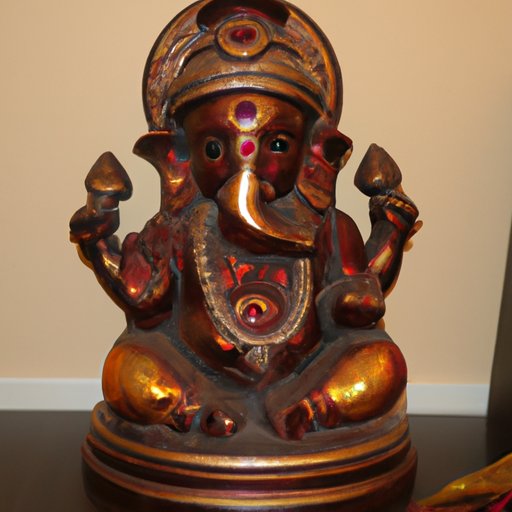
Introduction
Religion and culture are two concepts that are often intertwined. While they are distinct in their own right, they are also deeply interconnected. This article examines the relationship between religion and culture, exploring how religion shapes and influences culture, and how culture shapes and influences religion.

Definition of Religion and Culture
Before delving into the relationship between religion and culture, it is important to define both terms. According to the Oxford English Dictionary, religion is “the belief in and worship of a superhuman controlling power, especially a personal God or gods.” Culture, on the other hand, is defined as “the customs, arts, social institutions, and achievements of a particular nation, people, or other social group.” Thus, while religion is typically associated with faith and spiritual beliefs, culture encompasses a broader range of activities, values, and practices.

Overview of the Relationship Between Religion and Culture
The relationship between religion and culture can be seen throughout history. In many cases, religion has been used as a tool for shaping and influencing culture. For example, in the Middle Ages, the Catholic Church was a powerful force in European society, dictating laws and social norms. Similarly, in India, Hinduism has shaped the values, beliefs, and practices of Indian culture. In both cases, religion has played an integral role in shaping and influencing the culture of the societies in question.
Examining the Relationship Between Religion and Culture
In order to understand the relationship between religion and culture, it is important to examine how religion shapes and influences culture, as well as how culture shapes and influences religion.
Exploring the Role of Religion in Shaping and Influencing Culture
Religion plays a key role in shaping and influencing culture. As noted by sociologist Rodney Stark, “Religion is not just one element in the mix that makes up culture; it is the foundation of culture.” This is evident in many cultures around the world, where religious beliefs and practices have shaped the values, beliefs, and practices of the culture. For example, in the United States, Christianity has been a major influence in shaping the culture, from beliefs about marriage and family to political values. Similarly, in China, Confucianism and Buddhism have had a profound impact on Chinese culture.
Investigating How Religion Impacts the Cultural Identity of a Society
Religion also plays an important role in defining the cultural identity of a society. As noted by anthropologist Clifford Geertz, “Religion is a system of symbols which acts to establish powerful, pervasive, and long-lasting moods and motivations in men by formulating conceptions of a general order of existence and clothing these conceptions with such an aura of factuality that the moods and motivations seem uniquely realistic.” In other words, religion provides a sense of identity and purpose for a society, creating a shared set of beliefs and values that binds the members of the society together.

Analyzing the Impact of Religion on Social Values and Norms
Religion also has a significant impact on the social values and norms of a society. Religious beliefs and practices often serve as a guide for behavior, providing a moral framework for how people should interact with each other and behave in society. These values and norms are often embedded in the culture and passed down through the generations. For example, in the United States, Judeo-Christian values such as honesty, integrity, and hard work are highly valued and widely accepted.
Understanding the Differences Between Religious and Cultural Practices
It is important to note that there is a distinction between religious and cultural practices. While religious practices are based on faith and spiritual beliefs, cultural practices are based on traditions and customs. For example, in some cultures, certain foods are considered taboo, while in others, they are seen as a part of daily life. Similarly, in some religions, certain behaviors are forbidden, while in other religions, they are acceptable.
Revealing How Religion Can Shape Political and Economic Structures
Religion can also shape political and economic structures. In some cases, religious beliefs and practices have been used to justify oppressive political regimes. For example, in the Middle East, Islamic fundamentalism has been used to oppress women and minority groups. Similarly, in some parts of Africa, religious beliefs and practices have been used to support authoritarian leaders and oppressive economic systems.
Investigating the Influence of Religion on Art, Music, and Literature
Religion also has a significant impact on art, music, and literature. In many cases, religious beliefs and practices have served as a source of inspiration for artistic expression. For example, in the Christian tradition, art and literature often depict biblical stories and teachings. Likewise, in the Islamic tradition, art and literature often reflect the teachings of the Qur’an. Similarly, in many cultures, religious music and dance have been used as a way to express devotion and celebrate religious holidays and rituals.
Examining the Role of Religion in Art, Music, and Literature
In order to better understand the role of religion in art, music, and literature, it is important to examine how religious beliefs and practices have shaped and influenced artistic expression. For example, according to research conducted by the University of Toronto, religious iconography has been a common theme in art for centuries, with religious images being used to convey spiritual truths and inspire devotion. Similarly, religious music and dance have been used to commemorate religious holidays and rituals, and to explore themes of faith and spirituality.
Understanding the Impact of Religion on Artistic Expression
It is also important to consider the impact that religion has had on artistic expression. According to research conducted by the University of California, Los Angeles, religious beliefs and practices have often served as a source of inspiration for artists, inspiring them to create works that reflect their religious convictions. In addition, religious beliefs and practices have also served as a source of censorship, with some artists being censored or even persecuted for expressing ideas that were deemed contrary to religious beliefs.
Conclusion
In conclusion, this article has explored the relationship between religion and culture, examining how religion shapes and influences culture, and how culture shapes and influences religion. It has shown that religion has a significant impact on the values, beliefs, and practices of a culture, as well as on the cultural identity of a society. Additionally, it has revealed how religion can shape political and economic structures, and how it can influence art, music, and literature. Finally, it has demonstrated the interconnectedness of religion and culture, showing how the two are deeply intertwined.
Summary of the Relationship Between Religion and Culture
This article has demonstrated that religion and culture are deeply interconnected. Religion shapes and influences culture, and culture shapes and influences religion. Religion provides a sense of identity and purpose for a society, and serves as a guide for behavior and a source of inspiration for artistic expression. Thus, religion and culture are closely linked, and understanding the relationship between the two is essential for understanding the cultures of the world.
Implications for Future Research and Discussion
This article has highlighted the importance of understanding the relationship between religion and culture. Further research is needed to more fully explore how religion shapes and influences culture, and how culture shapes and influences religion. Additionally, further research is needed to more fully understand the impact of religion on social values and norms, as well as on art, music, and literature. Such research could provide valuable insight into the complex relationship between religion and culture, and help to better understand the cultures of the world.
(Note: Is this article not meeting your expectations? Do you have knowledge or insights to share? Unlock new opportunities and expand your reach by joining our authors team. Click Registration to join us and share your expertise with our readers.)