
Introduction
Air conditioning is a technology used to regulate the temperature, humidity, and cleanliness of air in an indoor environment. It can be found in homes, offices, stores, and many other places. The purpose of this article is to explain the science behind air conditioning and explore the different types, technologies, and benefits associated with it.

Explaining the Science Behind Air Conditioning
At its core, air conditioning is a process of transferring heat from one area to another. This is done by using a refrigerant, which is a substance that absorbs heat from the air and transfers it elsewhere. In order to understand how air conditioners work, it’s important to understand the principles of thermodynamics. Thermodynamics is the study of how energy is transferred between systems.
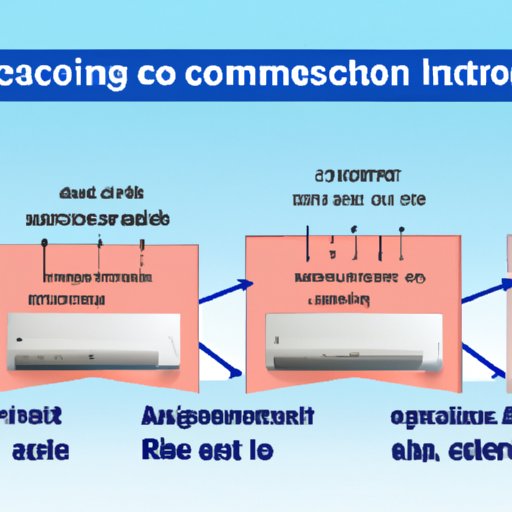
When an air conditioner is turned on, the compressor compresses the refrigerant gas into a liquid, causing it to become hot. This hot liquid is then passed through the condenser coils, where it releases its heat. The cooled liquid is then passed through the expansion valve, which reduces its pressure and causes it to evaporate into a gas. The evaporated gas is then passed through the evaporator coils, where it absorbs heat from the air. The cooled air is then circulated throughout the space, cooling it down.
The type of refrigerant used in an air conditioner can vary, but the most common are chlorofluorocarbons (CFCs), hydrochlorofluorocarbons (HCFCs), and hydrofluorocarbons (HFCs). Each type has its own advantages and disadvantages, and it’s important to choose the right one for your particular application.
Exploring Different Types of Air Conditioners
There are several different types of air conditioners available, each with its own unique features and benefits. The most common types are window units, split systems, packaged systems, ductless mini-splits, and heat pumps.
Window units are the most basic type of air conditioner and are typically used to cool small spaces such as bedrooms or offices. They are easy to install and relatively inexpensive, but they are not very efficient and can be noisy.
Split systems are more complex than window units and are typically used to cool larger spaces. They consist of two components: an outdoor unit and an indoor unit. The outdoor unit houses the compressor and condenser coils, while the indoor unit houses the evaporator coils. Split systems are more efficient than window units and can be quieter, but they are more expensive and require professional installation.
Packaged systems are similar to split systems, but they combine both the indoor and outdoor components into one unit. They are usually installed on the roof or outside of a building and are ideal for large commercial buildings or homes. They are more efficient and quieter than window units, but they are also more expensive and require professional installation.
Ductless mini-splits are similar to split systems, but they don’t require any ductwork. Instead, they use individual air handlers that are mounted on walls or ceilings. They are ideal for smaller spaces, are efficient and quiet, and don’t require professional installation. However, they are more expensive than window units.
Heat pumps are a type of air conditioner that can both cool and heat a space. They are more efficient than other types of air conditioners and can save money on energy bills. However, they are more expensive and require professional installation.
Examining the Components of an Air Conditioner
An air conditioner consists of four main components: a compressor, condenser coils, expansion valve, and evaporator coils. The compressor is responsible for compressing the refrigerant into a hot liquid. The condenser coils are responsible for releasing the heat from the hot liquid. The expansion valve reduces the pressure of the liquid and causes it to evaporate into a gas. Finally, the evaporator coils absorb heat from the air and cool it down.
Comparing Air Conditioning Technologies
Central air conditioning is the most common type of air conditioning system. It consists of a single unit that is connected to ductwork and is used to cool multiple rooms. It is efficient and relatively quiet, but it requires professional installation and can be expensive.
Geothermal systems use the energy stored in the ground to cool and heat a space. They are highly efficient and can save money on energy bills, but they are also expensive and require professional installation.
Solar-powered air conditioners use solar panels to generate electricity, which is then used to power the air conditioner. They are environmentally friendly and can save money on energy bills, but they are also expensive and require professional installation.

Outlining the Benefits of Air Conditioning
Air conditioning can provide numerous benefits, including improved air quality, increased energy efficiency, and lower operating costs. Air conditioners filter out dust, pollen, and other contaminants from the air, making it cleaner and healthier. Properly installed and maintained air conditioners can also be more energy efficient than other types of heating and cooling systems, resulting in lower energy bills. Additionally, air conditioners can reduce noise levels, making it easier to concentrate and sleep.

Analyzing the Cost of Air Conditioning
The cost of air conditioning varies depending on the size of the system and the type of technology used. Initial installation costs can range from a few hundred dollars for a window unit to several thousand dollars for a central air conditioning system. Maintenance and repair costs can also add up over time, and operating costs will depend on the efficiency of the system and how often it is used.
Conclusion
Air conditioning can provide numerous benefits, from improved air quality to increased energy efficiency. There are several different types and technologies available, each with its own advantages and disadvantages. Understanding the science behind air conditioning and exploring the different types, technologies, and benefits can help you make an informed decision about which type of air conditioner is best for your needs. Additionally, it’s important to consider the cost of air conditioning, including initial installation, maintenance, repair, and operating costs.
(Note: Is this article not meeting your expectations? Do you have knowledge or insights to share? Unlock new opportunities and expand your reach by joining our authors team. Click Registration to join us and share your expertise with our readers.)