
Introduction
Watches have been around for centuries and are an integral part of our lives. We use them to tell time, set alarms, and even track our fitness goals. But how do they actually work? This article will explore the anatomy, technology and history of watchmaking, helping readers understand how components work together, how different types of watches keep time, and the science behind quartz and automatic watches.
Explaining the Anatomy of a Watch: A Step-by-Step Guide
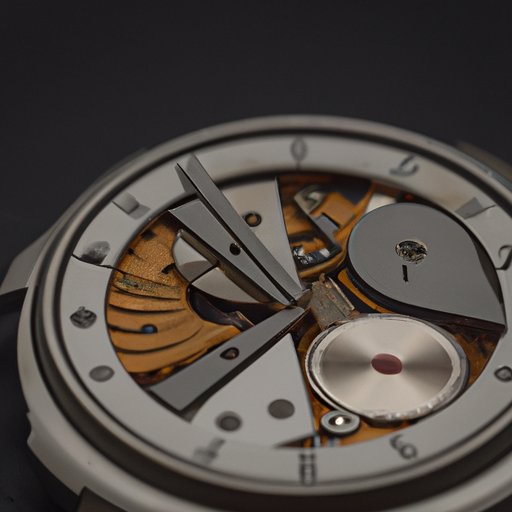
At its most basic level, a watch consists of a few key components: a case, a dial, hands, a crown, and a crystal. The case is the outer shell of the watch, which protects the internal components from damage. The dial is the face of the watch and contains the markings that indicate time. The hands are the pointers that rotate around the dial and point to the hours, minutes, and seconds. The crown is the small wheel on the side of the watch used to adjust the time and date. And finally, the crystal is a transparent cover that protects the dial from dust and scratches.
The components of a watch work together to display time. The movement, or engine, powers the watch and is responsible for keeping time. The mainspring stores energy and is wound by the crown. This energy is then released in a controlled manner and transmitted to the gears, which control the hands. The escapement regulates the release of energy and ensures that the watch keeps accurate time. Finally, the balance wheel oscillates back and forth, creating a steady rhythm that helps maintain accuracy.
In addition to the basic components, many watches also feature complications such as chronographs, moonphase indicators, and power reserve indicators. Chronographs are stopwatch functions that measure elapsed time. Moonphase indicators show the position of the moon in its cycle. And power reserve indicators show how much energy is left in the mainspring.

How Watches Keep Time: A Technical Overview
There are three main types of watches: quartz, automatic, and mechanical. Quartz watches use a battery to power a quartz crystal, which vibrates at a very precise frequency. The vibrations are then converted into electrical pulses that move the hands on the dial. Quartz watches are known for their accuracy and low cost.
Automatic watches are powered by a spring that is wound by the wearer’s motion. The spring transmits energy to the gears, which in turn move the hands. Automatic watches are typically more expensive than quartz watches, but they require less maintenance and can last longer.
Finally, mechanical watches are powered by a mainspring that must be manually wound. The mainspring transmits energy to the gears, which move the hands. Mechanical watches are highly accurate and require regular maintenance, but they are also the most expensive option.

A History of Time Keeping and How Watches Evolved
The history of timekeeping dates back thousands of years. Early methods included sundials, hourglasses, and water clocks. However, these methods were inaccurate and unreliable. It wasn’t until the 15th century that mechanical clocks began to appear, using weights and pendulums to keep time.
In the 18th century, watchmakers began to develop the first pocket watches. These watches featured mainsprings and gears that allowed them to keep accurate time. Over the next two centuries, watchmakers continued to refine their designs, introducing new materials and technologies.
In 1969, the quartz watch was invented. Quartz watches use a battery to power a quartz crystal, which vibrates at a very precise frequency. This allowed quartz watches to be even more accurate than mechanical watches. In the following decades, quartz watches become increasingly popular, eventually replacing mechanical watches as the most common type of watch.
Today, modern watches combine both quartz and mechanical technology. Many watches feature quartz movements, while others use automatic winding mechanisms to keep time. Some even feature solar cells that convert light into energy, allowing them to be powered by the sun.

The Science Behind Quartz Watches and How They Work
Quartz watches are powered by a battery that sends electricity to a quartz crystal. The crystal is cut in a specific shape and size and vibrates when electricity is applied. The vibrations create electrical pulses that are sent to a circuit board, which in turn moves the hands on the dial.
The quartz crystal is made up of two electrodes called anode and cathode. When the battery sends electricity to the crystal, the anode and cathode exchange electrons and generate an electric current. This current is then regulated by the circuit board and sent to the hands, which move and indicate the time.
Quartz watches are known for their accuracy and low cost. They require little maintenance and can last for years without needing to be replaced. However, they are not as reliable as mechanical watches, and the battery must be replaced periodically.
How Automatic Watches Utilize Winding to Keep Time
Automatic watches are powered by a mainspring that is wound by the wearer’s motion. The mainspring stores energy and transmits it to the gears, which move the hands on the dial. To wind the mainspring, the wearer must move their arm, which causes the rotor to spin and transfer energy to the mainspring.
The rotor is a weighted disc that is attached to the movement of the watch. As the wearer moves their arm, the rotor spins and winds the mainspring. The mainspring then releases energy in a controlled manner, which is transmitted to the gears and moves the hands on the dial.
There are several types of winding mechanisms used in automatic watches. Unidirectional winding utilizes a ratchet wheel that allows the mainspring to be wound in only one direction. Bidirectional winding uses a pawl that allows the mainspring to be wound in both directions. And finally, manual winding requires the user to turn the crown to wind the mainspring.
Conclusion
In conclusion, this article has explored the anatomy, technology and history of watchmaking. We discussed the components of a watch, how components work together, how different types of watches keep time, and the science behind quartz and automatic watches. From early timekeeping methods to modern advancements in watch technology, we now have a better understanding of how watches work and how they have evolved over the centuries.
(Note: Is this article not meeting your expectations? Do you have knowledge or insights to share? Unlock new opportunities and expand your reach by joining our authors team. Click Registration to join us and share your expertise with our readers.)