
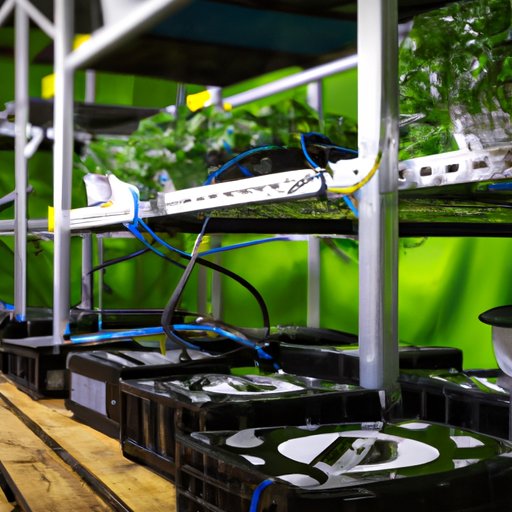

Overview of Crypto Farms: What They Are and How They Work
Crypto farms are specialized computer networks set up to mine cryptocurrencies, such as Bitcoin and Ethereum. While they can be large-scale operations, they can also be small-scale setups that anyone can build. Crypto farms are becoming increasingly popular as more people are turning to cryptocurrency investments. This article will provide an overview of crypto farms, exploring what they are, how they work, the different types of farms, the necessary equipment, risks and benefits, and potential profitability in the current market.
Definition of a Crypto Farm
A crypto farm is a computer network specifically designed for cryptocurrency mining, where miners use their computing power to solve complex mathematical problems in order to earn digital coins. These farms are set up with specialized hardware and software designed to maximize the efficiency of the mining process. The main purpose of a crypto farm is to generate a profit by mining cryptocurrencies.
Components of a Crypto Farm
Crypto farms consist of several components, including computers, cooling systems, and power supplies. The computers used in a crypto farm are typically high-end machines with powerful processors and graphics cards. These computers are connected to each other and the internet to form a network. Cooling systems are also necessary to maintain the optimal temperature for the computers to run efficiently. Finally, power supplies are necessary to ensure the proper functioning of the computers.

Steps to Setting Up a Crypto Farm
Setting up a crypto farm requires several steps. First, you need to purchase the necessary hardware and software. This includes computers, cooling systems, and power supplies. You then need to install the software on the computers and connect them to the network. After that, you need to configure the mining pool and the mining software. Finally, you need to monitor the performance of the crypto farm to ensure it is running optimally.

Exploring the Different Types of Crypto Farms
There are three main types of crypto farms: cloud mining, GPU mining, and ASIC mining. Cloud mining involves renting computing power from a remote server, while GPU mining uses graphics cards to mine cryptocurrencies. Finally, ASIC mining utilizes application-specific integrated circuits (ASICs) to mine cryptocurrencies. Each type of crypto farm has its own advantages and disadvantages, so it’s important to understand which type is best suited for your needs.

Understanding the Necessary Equipment for a Crypto Farm
In addition to the computers, cooling systems, and power supplies mentioned earlier, there is additional equipment needed to run a crypto farm. This includes computer hardware such as motherboards, CPUs, GPUs, and RAM. Software such as mining software, wallets, and exchanges are also necessary. Finally, a reliable electricity supply is essential for the efficient operation of a crypto farm.
Examining the Risks and Benefits of Running a Crypto Farm
Running a crypto farm comes with both risks and benefits. On the downside, the value of cryptocurrencies can fluctuate rapidly, which could lead to losses if the prices fall. Additionally, there is always the risk of a hack or theft of the coins mined. On the other hand, running a crypto farm can be profitable if the value of the coins increases and if the cost of running the farm is low.
Analyzing the Profitability of a Crypto Farm in the Current Market
The profitability of a crypto farm depends on several factors, including the cost of hardware, electricity, and maintenance. Additionally, the value of the coins mined must be taken into account when calculating profits. It is also important to compare the profitability of a crypto farm to other investment strategies, such as stock markets or real estate, to determine which one is the most profitable.
Crypto farms are becoming increasingly popular as more people turn to cryptocurrency investments. By understanding what crypto farms are, how they work, the different types of farms, the necessary equipment, risks and benefits, and potential profitability in the current market, investors can make informed decisions about whether or not to pursue this type of investment.
(Note: Is this article not meeting your expectations? Do you have knowledge or insights to share? Unlock new opportunities and expand your reach by joining our authors team. Click Registration to join us and share your expertise with our readers.)