
Introduction
Exploration is defined as “the action of traveling in or through an unfamiliar area in order to learn about it” (Lexico, 2020). Technology can be defined as “the application of scientific knowledge for practical purposes, especially in industry” (Lexico, 2020). For centuries, humans have been exploring the world around them, utilizing various technologies to make the process easier and more efficient. In this article, we will explore how changing technology has promoted exploration.
Examining the Impact of Improved Navigation Technology on Exploration
Navigation technology has had a significant impact on exploration. Since ancient times, people have used navigational instruments to help them find their way. According to NASA, the first navigational instruments included primitive tools like sticks, stars, and maps. Over time, these instruments became more advanced. By the 18th century, navigators were using compasses, sextants, and chronometers to determine their location.
The invention of GPS (Global Positioning System) in the 1970s revolutionized navigation technology. GPS uses satellites to pinpoint a person’s exact location and provide directions to their destination. This technology has enabled explorers to travel to far-off places with greater ease and accuracy. According to EurekAlert, GPS has also allowed scientists to track and study the movements of animals in the wild.
Analyzing the Benefits of Automation in Space Exploration
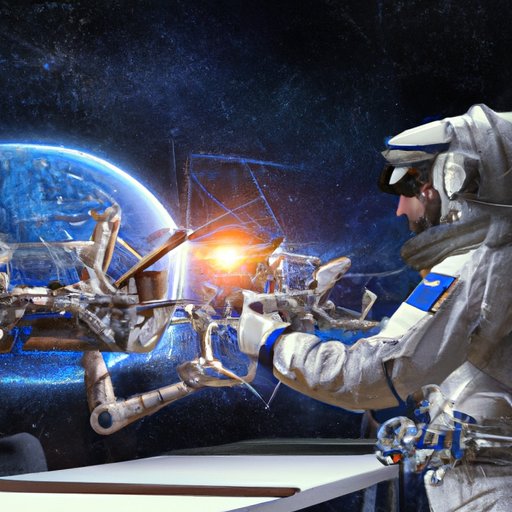
Automation has been a major contributor to the advancement of space exploration. Automation is the use of computers and robots to control processes that would otherwise be done manually. According to NASA, robots are used extensively in space exploration to do tasks that would be too dangerous or difficult for humans to do. For instance, robots are used to collect samples from other planets and asteroids, which helps scientists gain valuable insights into the composition of these objects.
Robots have also been used to construct and maintain spacecrafts. According to Space.com, robots have been used to build and repair the International Space Station, as well as other satellites and spacecrafts. This has enabled humans to explore farther reaches of space without having to worry about the dangers of space travel.
Exploring How Robotics Has Enabled More Precise Measurement of Distant Planets
Robotics has enabled more precise measurements of distant planets. According to Space.com, robotic probes are used to measure the temperature, pressure, and composition of planets and other celestial bodies. These probes are able to collect data from far-off places that would be impossible for humans to reach. This data has helped scientists better understand the composition of planets and other celestial bodies.
Investigating the Role of Satellite Imaging in Expanding Our Understanding of the Universe
Satellite imaging has played an important role in expanding our understanding of the universe. According to Space.com, satellites have enabled us to observe the Earth and other planets in unprecedented detail. Satellites have also enabled us to observe distant stars and galaxies that would otherwise be impossible to see. This has allowed us to gain valuable insights into the structure and composition of the universe.
Discussing the Contributions of Artificial Intelligence to the Advancement of Exploration
Artificial intelligence (AI) has also played a role in the advancement of exploration. According to Space.com, AI is used to analyze data from spacecrafts and satellites and identify patterns and trends. AI can also be used to plan missions and make decisions in real-time. This has enabled us to explore new frontiers with greater efficiency and accuracy.
Conclusion
In conclusion, changing technology has played an important role in promoting exploration. Improved navigation technology has enabled us to travel to far-off places with greater ease and accuracy. Automation and robotics have enabled us to explore space with greater efficiency and safety. Satellite imaging has allowed us to observe distant stars and galaxies. And finally, AI has enabled us to analyze data and plan missions with greater precision. All of these technologies have helped us expand our knowledge of the universe.
(Note: Is this article not meeting your expectations? Do you have knowledge or insights to share? Unlock new opportunities and expand your reach by joining our authors team. Click Registration to join us and share your expertise with our readers.)