
Introduction
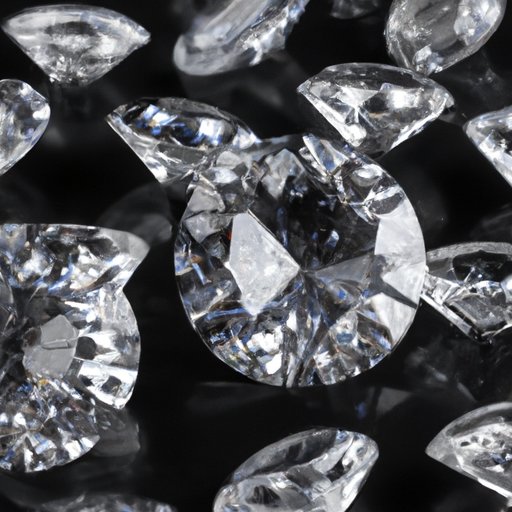
Diamonds are one of the most beautiful and sought-after gemstones in the world. Their rare beauty and brilliance has captivated people for centuries, and they have been treasured and used in jewelry since ancient times. But what exactly are diamonds? Are they minerals? In this article, we will explore the science behind diamonds and answer the question: are diamonds minerals?
A Geologist’s Guide to Diamonds: Mineralogy, Formation and Properties
Before delving into the specifics of diamonds, it is important to understand the definition of a mineral. According to the International Mineralogical Association, “a mineral is a naturally occurring inorganic solid, with a definite chemical composition and an ordered atomic arrangement.” The term “inorganic” means that the material does not contain carbon, which eliminates all organic materials such as wood or bones.
So, are diamonds minerals? The answer is yes. Diamonds fit the criteria of being an inorganic solid, composed of carbon atoms arranged in a specific crystal structure. The chemical formula of diamond is C, meaning that it is composed entirely of carbon atoms.
Diamonds form deep within the Earth’s mantle, usually at depths of over 100 miles (160 km). This process is known as “diamond stability” and occurs when extreme temperatures and pressures create the right conditions for carbon atoms to crystallize into diamond. The diamonds then travel up to the surface via volcanic eruptions.
Diamonds are renowned for their strength and hardness, making them the hardest natural material on Earth. According to the Mohs scale of mineral hardness, diamonds rate a 10 out of 10 – the highest rating possible. They are also incredibly durable, able to withstand extreme temperatures and pressure. Additionally, diamonds possess excellent optical properties, with a refractive index of 2.417 and dispersion of 0.044.
What Makes Diamonds So Valuable? Exploring the Science Behind the Gemstone
The rarity of diamonds makes them highly desirable and valuable. Natural diamonds are formed under very specific conditions and can only be found in select places around the world. According to a study published in Nature Communications, “the majority of primary diamond deposits are located in the cratonic lithosphere of the continents.”
Diamonds come in a variety of colors, ranging from colorless to yellow, pink, blue and even black. The different colors are caused by trace elements such as nitrogen or boron that become trapped in the crystal lattice during the formation process. Colorless diamonds are the most valuable, followed by fancy-colored diamonds.
The durability and hardness of diamonds make them ideal for use in jewelry. They can withstand scratches and wear and tear, making them longer lasting than other gems. Furthermore, their optical properties give them a unique sparkle and luster that is unparalleled.

The History of Diamonds: From Ancient Times Until Now
Diamonds have been used in jewelry and art since ancient times. The earliest known use of diamonds dates back to 4th century BC India, where they were used to decorate swords and sculptures. By the 13th century, diamonds had become popular in Europe, particularly among royalty and the wealthy. During the Renaissance period, diamonds were used to adorn rings, necklaces and other pieces of jewelry.
Diamonds have been treasured throughout history for their beauty and rarity. They have been used to symbolize love, commitment and wealth, and are still popular today. For example, diamonds are now commonly used in engagement rings and wedding bands.
How Are Diamonds Mined? An Overview of the Extraction Process
Diamonds are extracted from kimberlite pipes, which are formed by volcanic eruptions millions of years ago. There are two main types of diamond mining methods: open-pit mining and underground mining. Open-pit mining involves removing the soil and rocks above the kimberlite pipe, while underground mining involves extracting diamond-bearing ore from tunnels and shafts.
The environmental impact of diamond mining is significant. Open-pit mining involves large-scale land clearing and disruption of ecosystems, while underground mining can lead to groundwater contamination and air pollution. In addition, many diamond mining companies operate without proper regulations, leading to human rights abuses and exploitation.
The Role of Diamonds in Jewelry: From Engagement Rings to Necklaces
Diamonds are one of the most popular gemstones used in jewelry. They are renowned for their beauty and brilliance, and are often used to symbolize love and commitment. Diamonds are commonly used in engagement rings, wedding bands, necklaces and earrings.
Diamonds come in a variety of shapes and sizes, with the most popular being round, princess, cushion and oval. Different cuts of diamonds can affect their appearance and value, so it is important to choose the right cut for your needs.

Synthetic Diamonds: A Revolution in the Jewelry Industry
In recent years, synthetic diamonds have become increasingly popular in the jewelry industry. Synthetic diamonds are created in a laboratory using advanced technology, and typically possess the same chemical, physical and optical properties as natural diamonds. However, they are much less expensive than natural diamonds.
There are several advantages to using synthetic diamonds. They are ethically produced, so there is no need to worry about human rights abuses or environmental degradation. Furthermore, they are available in a wide range of colors, including rare colors such as yellow and pink. Finally, they are significantly cheaper than natural diamonds.
However, the synthetic diamond market faces several challenges. Many consumers are still unaware of synthetic diamonds, and there is a stigma surrounding them due to their artificial origin. Additionally, some jewelers are reluctant to sell them due to their lower price point.
Conclusion
Diamonds are one of the most beautiful and valuable gemstones in the world. They are minerals, composed of carbon atoms arranged in a specific crystal structure. They form deep within the Earth’s mantle and are prized for their rarity, brilliance and durability. Diamonds have been used in jewelry and art since ancient times, and remain popular today. They can be mined from kimberlite pipes, but the process has significant environmental impacts. Synthetic diamonds are becoming increasingly popular in the jewelry industry, offering an ethical alternative to natural diamonds.
(Note: Is this article not meeting your expectations? Do you have knowledge or insights to share? Unlock new opportunities and expand your reach by joining our authors team. Click Registration to join us and share your expertise with our readers.)