
Introduction
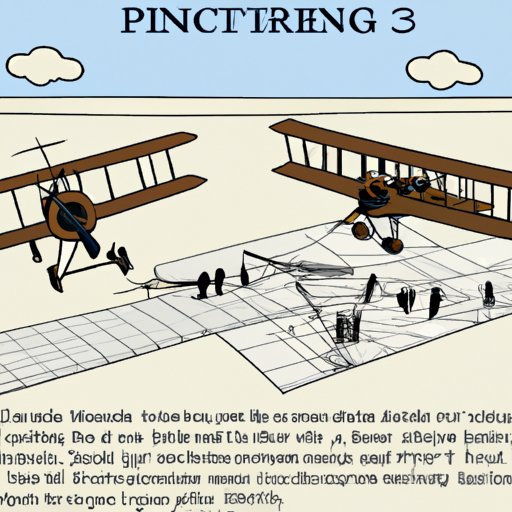
The Wright Brothers’ invention of a powered, controlled, and sustained airplane in 1903 is widely regarded as one of the most significant technological advancements in human history. Wilbur and Orville Wright’s first successful flight marked the dawn of a new era in transportation and communication, revolutionizing the way people travel, conduct business, and wage war. This article will explore why the Wright Brothers decided to invent the airplane and examine the impact of their innovation on modern technology and society.
Examining the Wright Brothers’ Childhood and Early Interest in Aviation
Wilbur and Orville Wright were two of seven children born to Milton and Susan Wright in Dayton, Ohio. Although neither brother received formal education past high school, they developed a keen interest in science and mechanics from an early age. As teens, the brothers began to experiment with kites and gliders, and even constructed their own printing press.
In 1899, the Wright Brothers read about German engineer Otto Lilienthal’s experiments with gliders. Inspired by Lilienthal’s work, Wilbur and Orville began to make plans for their own manned flying machine. The brothers wrote to the U.S. Weather Bureau requesting information on wind patterns at different altitudes, and they studied books on aerodynamics and mathematics to better understand the principles of flight.
Analyzing the Scientific and Technical Challenges Faced by the Wright Brothers
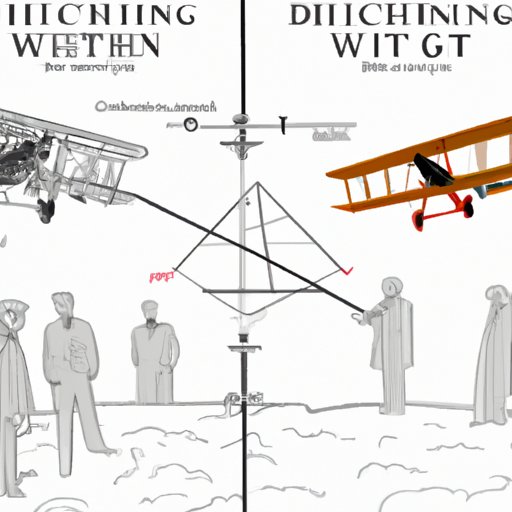
The Wright Brothers needed to solve a number of scientific and technical challenges before they could build a successful airplane. First, they had to understand the basics of aerodynamics, which governs the motion of air around an object. They also had to design a propeller that could generate sufficient thrust to lift the craft off the ground, as well as an engine light enough to power the plane.
In 1902, Wilbur and Orville built a wind tunnel and tested over 200 different wing designs to determine the most efficient shape for their aircraft. After several failed attempts, the brothers finally succeeded in constructing a craft that could fly. On December 17th, 1903, Orville piloted the first successful flight in Kitty Hawk, North Carolina, traveling 120 feet in 12 seconds.
Exploring the Impact of the Wright Brothers’ Inventions on Transportation and Society
The Wright Brothers’ invention of the airplane had a profound impact on transportation and society. Within a few years of their first successful flight, commercial airlines began offering passenger flights, allowing people to travel great distances in a fraction of the time it took before. These advances in air travel opened up new opportunities for trade, tourism, and international relations.
The development of commercial air travel also had a major economic impact. According to a study conducted by the International Air Transport Association, the global aviation industry generates more than $2.7 trillion in economic activity and supports almost 65 million jobs worldwide.
Investigating How the Wright Brothers’ Invention Changed Warfare
The invention of the airplane revolutionized warfare as well. Military aircraft allowed nations to launch attacks from the air and transport troops, supplies, and weapons quickly and efficiently. During World War I, airplanes were used for reconnaissance, bombing, and dogfights between fighter planes.
Airplanes also enabled soldiers to drop bombs from greater heights and with greater accuracy than ever before. This gave countries a decisive advantage in battle and led to the development of new strategies, tactics, and technologies.
Identifying the Role of Competition in Driving the Wright Brothers to Invent the Airplane
The Wright Brothers were driven to invent the airplane by a desire to prove themselves against their rivals. Samuel Langley, a scientist at the Smithsonian Institution, was working on his own version of a powered, manned aircraft at the same time that Wilbur and Orville were. The Wright Brothers felt that if they could beat Langley to the punch and be the first to fly, they would gain recognition and respect in the scientific community.
The Wright Brothers’ competitive spirit drove them to work harder and faster than their rivals. Their relentless dedication and determination eventually paid off, and their invention of the airplane secured their place in history.
Discussing the Innovative Design Features of the Wright Brothers’ Airplane
The Wright Brothers’ airplane featured several innovative design features that set it apart from its predecessors. Most notably, the brothers incorporated a three-axis control system, which allowed the pilot to control the aircraft’s pitch, yaw, and roll. This was a revolutionary concept at the time, as previous aircraft relied on fixed wings for stability.
The Wright Brothers also perfected the design of their airplane’s propeller, which generated more thrust than any other propeller of its day. Finally, the brothers implemented a technique called “wing warping” to help maintain the aircraft’s balance and stability during flight.
Evaluating the Legacy of the Wright Brothers’ Invention
The Wright Brothers’ invention of the airplane has had a lasting impact on the field of aviation and on modern technology. Their innovation inspired generations of engineers and scientists to pursue their dreams of flight and pushed the boundaries of what is possible. Today, airplanes are used for transportation, recreation, and military purposes, and they remain one of the most important inventions of all time.
Conclusion
The Wright Brothers’ invention of the airplane revolutionized transportation and communication, enabling people to travel farther and faster than ever before. This article explored why the Wright Brothers decided to invent the airplane and examined the impact of their innovation on society and modern technology. The Wright Brothers’ contribution to the field of aviation continues to inspire future generations and has had a lasting impact on the world.
(Note: Is this article not meeting your expectations? Do you have knowledge or insights to share? Unlock new opportunities and expand your reach by joining our authors team. Click Registration to join us and share your expertise with our readers.)