
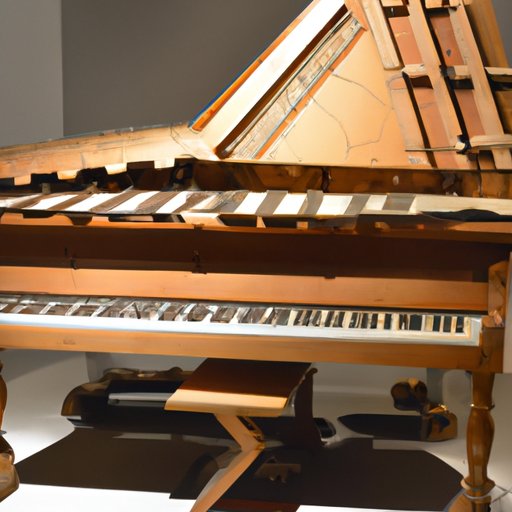
Introduction
The piano is one of the most iconic instruments in the world, known for its versatility and ability to blend with any genre of music. But when were pianos invented? To answer this question, we must look at the instrument’s fascinating history and evolution, from its humble beginnings up to the modern day.
At its core, a piano is a musical keyboard instrument that produces sound by striking strings with felt hammers. It is typically made up of a wooden cabinet, metal strings, a soundboard, and a keyboard. The player presses the keys on the keyboard to activate the hammers, which then strike the strings to produce sound.
Historical Perspective on the Invention of the Piano
To understand the evolution of the piano, it is important to trace its roots back in time. Before the piano, a few other instruments existed that had similar features. The harpsichord was an early predecessor of the piano, developed in 16th century Italy. It featured a keyboard like the piano and strings that were plucked by quills rather than struck with hammers. The clavichord was also developed during this era, but it was much smaller and quieter than the harpsichord.
However, it wasn’t until 1709 that the piano was officially invented by Italian musician and craftsman Bartolomeo Cristofori. He developed the first piano prototype with a hammer action keyboard and strings that could be struck to create sound. This invention revolutionized the music industry and ushered in a new era of instrument design.

Evolution and Development of the Piano
Since its invention, the piano has gone through many changes and modifications. Early pianos had a much simpler design than modern pianos. They were typically constructed with a single string per key and a much shorter keyboard than what we have today. These early models were also much quieter than their modern counterparts.
In the mid-1700s, the grand piano was developed. This instrument featured a longer keyboard and multiple strings per key, allowing for a much fuller sound and greater dynamic range. Over the years, the grand piano has become the most popular type of piano due to its size, sound quality, and versatility.
Upright pianos were also developed during this era. These instruments are smaller than grand pianos and feature strings that run vertically rather than horizontally. Upright pianos are still popular today due to their compact size and affordability.

Inventor Spotlight: Bartolomeo Cristofori and the Birth of the Piano
Bartolomeo Cristofori was an Italian musician and craftsman who is credited with inventing the piano. Born in Padua, Italy in 1655, he was highly regarded in his time as a skilled instrument maker. He was commissioned by the Grand Prince of Tuscany, Ferdinando de’ Medici, to design and build a new kind of instrument.
Cristofori’s invention was revolutionary in that it featured a hammer action keyboard that allowed the player to control both the volume and tone of the instrument. This enabled musicians to play with more expression and nuance than ever before. His invention quickly caught on and soon became an essential part of music making.

A Comparative Analysis of Early Pianos vs Modern Pianos
Early pianos had a much simpler design than modern pianos. They were usually constructed with a single string per key, a shorter keyboard, and a much quieter sound. By comparison, modern pianos are constructed with multiple strings per key and a longer keyboard. This allows for a fuller sound and greater dynamic range.
The construction of modern pianos is also much more complex than that of early models. Modern pianos are built with intricate systems of levers, springs, and dampers that allow for precise control of the instrument’s sound. This makes modern pianos much more versatile and expressive than their predecessors.
Finally, the performance of modern pianos is far superior to that of early models. Modern pianos are designed to hold their tuning for longer periods of time and are capable of producing a wider range of sounds. This allows modern pianists to express themselves with greater freedom and nuance than ever before.
How the Piano Changed Music History
Since its invention, the piano has had a profound impact on the course of music history. In the classical realm, composers such as Mozart, Beethoven, and Chopin wrote some of their greatest works for the instrument. The piano’s dynamic range and expressive capabilities allowed these composers to create some of the most beautiful and powerful music ever written.
The piano also had a profound influence on jazz music. Musicians such as Duke Ellington, Bill Evans, and Oscar Peterson used the instrument to push the boundaries of the genre and create some of the most innovative and influential jazz music of all time.
Finally, the piano is one of the most popular instruments in pop music. Its versatility and accessibility make it the perfect instrument for songwriters and producers looking to create hit songs. From Elton John to Adele, the piano has been used to create some of the most iconic pop songs of all time.
Conclusion
The invention of the piano has had a profound impact on the course of music history. While the instrument has gone through many changes and modifications over the years, it still retains its iconic status as one of the most beloved and versatile instruments in the world. Thanks to the genius of Italian inventor Bartolomeo Cristofori, the piano continues to be a source of joy, inspiration, and creativity for generations to come.
(Note: Is this article not meeting your expectations? Do you have knowledge or insights to share? Unlock new opportunities and expand your reach by joining our authors team. Click Registration to join us and share your expertise with our readers.)