
Introduction
Sound is an integral part of our lives; it is a vibration that travels through a medium such as air or water, and is perceived by our ears. It is a form of energy, and has been studied extensively by scientists and researchers in many different fields. This article will provide an overview of the science of sound, including its physical properties, how we hear it, and its various applications.
Exploring the Physics of Sound: An Overview
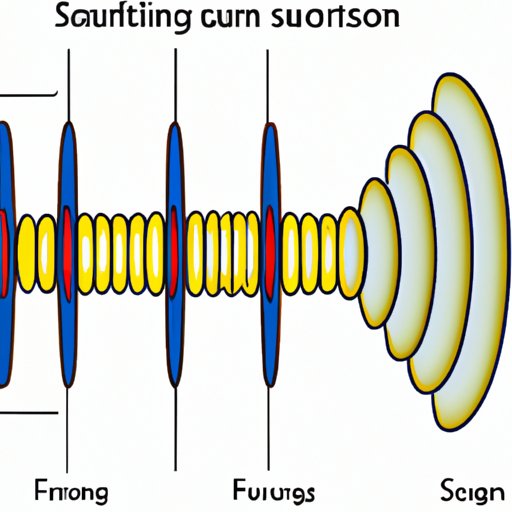
At the heart of sound is the physics behind it. Sound is created when something vibrates, causing molecules in the surrounding environment to move back and forth. These vibrations create waves, which travel through a medium such as air or water. The two most important characteristics of sound waves are their frequency and amplitude.
Frequency is measured in Hertz (Hz), and refers to the number of times a wave completes one cycle per second. The higher the frequency, the higher the pitch of the sound. Amplitude is measured in decibels (dB), and is the strength or intensity of the sound. The higher the amplitude, the louder the sound.
There are several different types of sound waves, including longitudinal waves and transverse waves. Longitudinal waves, also known as compression waves, move in the same direction as their source, while transverse waves, also known as shear waves, move perpendicular to their source. Other types of sound waves include constructive interference, destructive interference, and diffraction.
Reflection, refraction, and diffraction are also important concepts when exploring the physics of sound. Reflection occurs when a sound wave bounces off a surface, while refraction occurs when a sound wave changes direction as it passes through different media. Diffraction is the bending of a sound wave around an obstacle.
The Science Behind How We Hear
In order to understand how we hear sound, we must first look at the anatomy of the ear. The ear is composed of three main parts: the outer ear, the middle ear, and the inner ear. The outer ear consists of the pinna, which helps to collect sound waves, and the auditory canal, which leads to the eardrum. The middle ear contains the ossicles, which are three tiny bones that amplify sound vibrations, and the Eustachian tube, which helps to maintain equal air pressure on both sides of the eardrum.
The inner ear contains the cochlea, which is filled with fluid and lined with thousands of tiny hairs called cilia. When sound waves enter the ear, they cause the eardrum and ossicles to vibrate, which then causes the cilia to move. This movement creates electrical signals, which are then sent to the brain and interpreted as sound.

Investigating the Properties of Sound Waves
Sound waves have several interesting properties, including wavelength, velocity, and resonance. Wavelength is the distance between two successive points of a wave, and is measured in meters. Velocity is the speed at which a wave propagates through a medium, and is measured in meters per second. Resonance is the tendency of a system to oscillate at a greater amplitude at certain frequencies.
When sound waves interact with objects, they can produce various effects. For example, when a sound wave strikes a solid object, it can cause the object to vibrate. This vibration can create a secondary sound wave, which is known as reverberation. Reverberation can be used to create special effects in music and recording studios.
Understanding the Components of Music and Audio
Music and audio rely heavily on the properties of sound waves. Pitch is the frequency of a sound, and is what gives a sound its distinct tone. Timbre is the quality of a sound, and is determined by the harmonic content of a sound. Dynamics refer to the volume of a sound, and can range from soft to loud.
Volume is the amount of energy in a sound wave, and is measured in decibels. Higher volumes result in louder sounds, and lower volumes result in softer sounds. Volume is an important component of music and audio production, as it allows for greater control over the intensity of a sound.

Examining the Effects of Sound on the Human Body
Sound has both psychological and physiological effects on the human body. On a psychological level, sound can evoke strong emotions, such as fear or joy. It can also be used to create an atmosphere or mood, and can influence our behavior. Physiologically, sound can affect our heart rate, blood pressure, and breathing rate.
Exposure to loud sounds can also lead to hearing loss. Prolonged exposure to loud noise can damage the delicate structures of the inner ear, leading to permanent hearing impairment. It is important to protect your ears from loud noises, as hearing loss is irreversible.

A Comprehensive Guide to Acoustics
Acoustics is the study of the production, transmission, and reception of sound. It encompasses a wide range of topics, including the behavior of sound in enclosed spaces, the design of concert halls and recording studios, and the use of sound in medical imaging. Acousticians use mathematical models and computer simulations to analyze and predict the behavior of sound.
The principles of acoustics can be applied to a variety of practical applications, such as the design of noise-canceling headphones, the optimization of sound systems, and the construction of soundproof rooms. Acoustics is also used in the development of new musical instruments and the improvement of existing ones.
Conclusion
This article has provided an overview of the science of sound, from its physical properties to its psychological and physiological effects. We explored the physics of sound waves, how we hear them, and the components of music and audio. We also looked at the effects of sound on the human body, and discussed the principles of acoustics and its various applications.
For those interested in learning more about the science of sound, there are many excellent resources available. Online courses, books, and websites can provide a wealth of information on the subject. Additionally, attending lectures and seminars by experts in the field can be a great way to deepen your understanding of the science.
(Note: Is this article not meeting your expectations? Do you have knowledge or insights to share? Unlock new opportunities and expand your reach by joining our authors team. Click Registration to join us and share your expertise with our readers.)