
Introduction
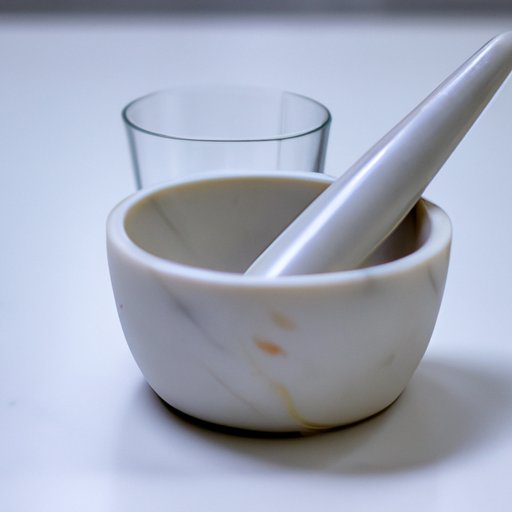
A mortar and pestle is an ancient tool used by chemists, pharmacists, herbalists, and other scientists to grind solids into fine powders. It consists of two parts: a bowl-shaped mortar, which is usually made of stone, ceramic, or metal, and a crushing rod, referred to as a pestle. Together, these two components are used to reduce solid materials into smaller particles for further analysis or processing.
The mortar and pestle has been used for centuries in various forms and is still a vital tool in scientific research today. From breaking down samples into smaller particles to grinding substances into powders, there are many applications for this versatile tool in the laboratory.
Exploring the Role of a Mortar and Pestle in Scientific Research
One of the primary uses of a mortar and pestle in scientific research is to break down samples into smaller particles. This is especially useful when working with delicate materials that cannot be easily handled with other tools. For example, a mortar and pestle can be used to crush fragile plant specimens into smaller pieces for easier study.
In addition to reducing the size of samples, a mortar and pestle can also be used to mix and blend ingredients. Scientists often utilize this tool to combine different chemicals or reagents for use in experiments. By grinding these substances together in a mortar and pestle, it ensures that all elements are thoroughly mixed for accurate results.
Finally, a mortar and pestle is also used to grind substances into powders, which is essential for certain types of scientific studies. For instance, researchers may need to grind up a sample of soil or sediment to analyze the properties of the particles within. A mortar and pestle allows them to break down the material into a finer powder, making it easier to study under a microscope.
The Versatility of a Mortar and Pestle in Science Laboratories
There are many different types of mortars and pestles available, each designed to suit specific needs. For example, some mortars and pestles are made out of ceramic, which is ideal for grinding softer materials like spices or herbs. Other versions are made of metal, which is better suited for tougher materials such as rocks or minerals.
Mortars and pestles can be used in a variety of disciplines within the sciences, including chemistry, biology, and geology. For instance, a chemist may use a mortar and pestle to mix and blend different elements for an experiment, while a biologist could use one to grind up plant specimens for further analysis. Geologists may use a mortar and pestle to grind up rock samples for examination.
When choosing a mortar and pestle for your laboratory, it is important to consider the type of material you will be working with and the size of the particles you need to produce. Different mortars and pestles are designed for different purposes, so it is important to pick the right one for your specific needs.

A Guide to Utilizing a Mortar and Pestle in Scientific Experiments
Before using a mortar and pestle in a laboratory setting, it is important to understand the proper handling and storage of this tool. Always make sure to wear protective gloves and eye protection when operating a mortar and pestle, as the particles created can cause irritation to the skin and eyes. In addition, it is important to store the mortar and pestle in a dry place away from direct sunlight to avoid damage.
When using a mortar and pestle in scientific experiments, there are several steps to follow. First, prepare the sample by washing and drying it thoroughly. Next, place the sample in the mortar and begin to grind it with the pestle. Be sure to use gentle, circular motions to ensure that all particles are broken down into a fine powder. Finally, remove the powder from the mortar and store it in an airtight container until ready for use.
It is also important to take safety precautions when using a mortar and pestle. Be sure to keep the workspace clean and free of debris to avoid contamination of the sample. Additionally, avoid inhaling the dust created by the grinding process to prevent respiratory irritation.

How a Mortar and Pestle is Used in Scientific Studies
A mortar and pestle is used in a variety of scientific studies, from analyzing soil composition to studying the effects of drugs on organisms. For example, in a study conducted by researchers at the University of Tokyo, a mortar and pestle was used to grind up plant specimens for analysis of their chemical composition.1 This allowed the researchers to accurately measure the concentrations of various compounds present in the plants.
In addition to measuring chemical properties, a mortar and pestle can also be used to study the physical properties of materials. For instance, in a study published in the journal Applied Physics Letters, researchers used a mortar and pestle to grind up carbon nanotubes for further analysis.2 This enabled the researchers to measure the electrical and thermal properties of the nanotubes.
Using a mortar and pestle in scientific studies has several advantages. It is a relatively inexpensive tool that can be used for a wide range of applications. Furthermore, it provides a more accurate way of measuring properties than other methods, such as sieving or filtering.

The Significance of a Mortar and Pestle in Science
The mortar and pestle has a long history in science, dating back to ancient civilizations. It has been used by chemists, pharmacists, herbalists, and other scientists for centuries to prepare and analyze samples. Its continued use in modern research demonstrates its importance in the scientific community.
Today, the mortar and pestle remains an invaluable tool in laboratories around the world. From breaking down samples into smaller particles to grinding substances into powders, this versatile tool is essential for conducting accurate scientific experiments and studies.
Conclusion
The mortar and pestle is an essential tool in scientific research and experiments. From breaking down samples into smaller particles to grinding substances into powders, this versatile tool has many applications in the laboratory. Its historical significance and continued use in modern research demonstrate the importance of this tool in the scientific community.
(Note: Is this article not meeting your expectations? Do you have knowledge or insights to share? Unlock new opportunities and expand your reach by joining our authors team. Click Registration to join us and share your expertise with our readers.)