
Introduction
Music has been used throughout history as a form of expression, entertainment, and communication. In recent years, scientists have begun to explore the neuroscience behind music and its effects on the brain. This article seeks to explore what happens to the brain when you listen to music, and how music can be used to enhance cognitive performance.
Exploring the Cognitive Benefits of Music: What Happens When You Listen?
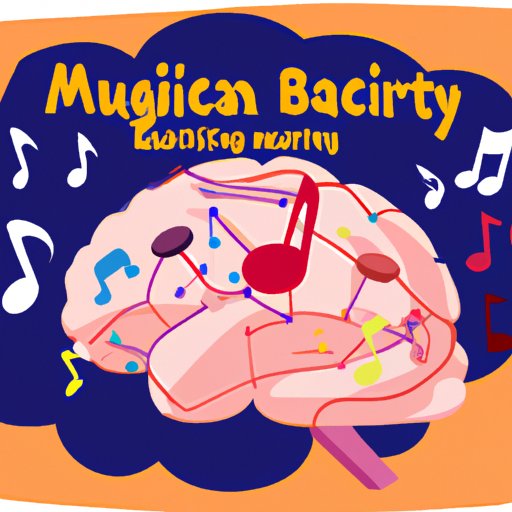
When you listen to music, it engages multiple areas of the brain. It activates the auditory cortex, which is responsible for processing sound. It also stimulates the limbic system, which is associated with emotion and reward. Additionally, music engages other areas of the brain, including the motor cortex, pre-frontal cortex, and hippocampus.
Music has the power to enhance cognitive performance. Studies have shown that people who listen to music before a task or during a task are able to focus better, recall information more quickly, and solve problems more efficiently. Music can also help to improve memory formation and retrieval.

Music and Memory: How Music Engages the Brain
Music helps to store and retrieve information by engaging multiple areas of the brain. Studies have found that music activates the auditory cortex, which processes sound. It also stimulates the prefrontal cortex, which is associated with memory formation and retrieval. Additionally, music engages the hippocampus, which plays a role in long-term memory.
Listening to music can also help to improve memory recall. Studies have shown that people who listen to music while studying are more likely to remember the material than those who don’t. Music helps to engage the brain and create a mental map of the material that is being studied.
How Music Stimulates Different Areas of the Brain
When you listen to music, it activates the auditory cortex, which is responsible for processing sound. This area of the brain is also associated with language and speech. Additionally, music stimulates the limbic system, which is associated with emotions and rewards. The limbic system is also involved in memory formation and retrieval.
Music also stimulates other areas of the brain, including the motor cortex, pre-frontal cortex, and hippocampus. The motor cortex helps to control movement, while the pre-frontal cortex is associated with decision making and problem solving. The hippocampus is involved in long-term memory formation and recall.

The Power of Music: How Music Enhances Cognitive Performance
Music has the power to enhance cognitive performance. Studies have shown that people who listen to music before a task or during a task are able to focus better, recall information more quickly, and solve problems more efficiently. Music also helps to improve concentration and focus.
Additionally, music can help to enhance learning and problem solving abilities. Studies have found that music can increase alpha brain waves, which are associated with increased creativity, improved problem solving skills, and enhanced learning. Music can also help to reduce stress and anxiety, which can improve cognitive performance.
How Music Influences Mood, Emotion and Behavior
Music has a powerful effect on mood, emotion, and behavior. Listening to upbeat music has been shown to lift one’s mood, while listening to slower, more calming music can help to reduce stress and anxiety. Music can also help to regulate emotions and reduce impulsivity and aggression.
Studies have also found that music can help to improve self-esteem and self-confidence. Listening to music has been found to increase levels of dopamine, which is associated with pleasure and motivation. Music can also help to reduce symptoms of depression, anxiety, and stress.

The Link Between Music and Creativity: How Music Helps Your Brain Unlock Its Potential
Music has a powerful effect on creativity. Studies have found that musical improvisation can increase creativity, as it requires the brain to think outside the box and come up with creative solutions. Music can also help to improve creative thinking and decision making.
Additionally, music can help to stimulate divergent thinking, which is the ability to come up with multiple ideas and solutions to a problem. This type of thinking is essential for creative problem solving and decision making.
Conclusion
This article has explored the neuroscience behind music and how it affects the brain. We have seen how music engages multiple areas of the brain, stimulates different regions, and enhances cognitive performance. We have also discussed how music influences mood, emotion, and behavior, as well as its link to creativity.
In conclusion, music has a powerful effect on the brain. It can help to improve focus and concentration, enhance learning and problem solving abilities, and stimulate creativity. For those looking to unlock their potential, music may be the key.
(Note: Is this article not meeting your expectations? Do you have knowledge or insights to share? Unlock new opportunities and expand your reach by joining our authors team. Click Registration to join us and share your expertise with our readers.)