
Introduction
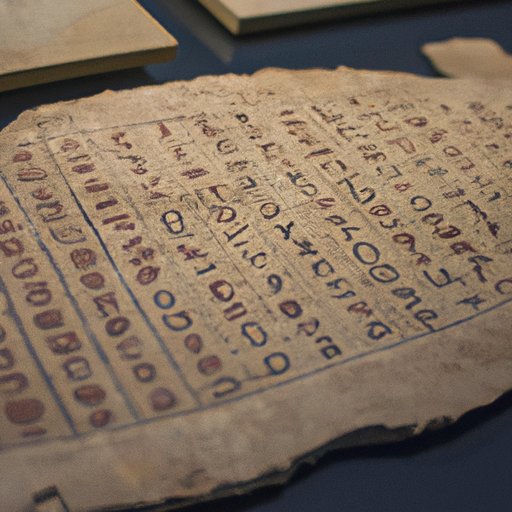
Cuneiform is an ancient form of writing originating from the ancient Near East. It is a system of wedge-shaped symbols or characters that were inscribed on clay tablets or other surfaces. The word “cuneiform” comes from the Latin word for “wedge-shaped” and has been used since the 18th century to refer to this type of writing. Cuneiform is one of the earliest forms of writing and it is believed to have been developed by the Sumerian people in Mesopotamia around 3200 BC.
The Origins of Cuneiform
The origin of cuneiform has been a source of debate among scholars for centuries. While some historians believe that the Sumerians developed cuneiform independently, others argue that they acquired the knowledge from another civilization. One theory suggests that the Sumerians may have borrowed their writing system from the Elamites, who lived in what is now Iran. Whatever its origin, cuneiform quickly became the most widely used writing system in the ancient Near East.
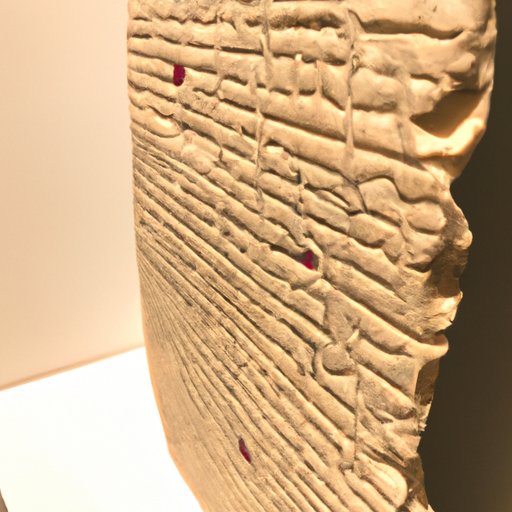
The first written records in cuneiform date back to around 3200 BC, when the Sumerians began to inscribe symbols onto wet clay tablets. Over time, the Sumerians developed a complex system of writing that incorporated more than 600 different symbols. The language they used was known as Sumerian and was written in a script known as cuneiform. This writing system was adopted by other civilizations such as the Babylonians, Assyrians, and Hittites, who modified the symbols and added their own words to the language.
Deciphering the Secrets of Cuneiform
In the 19th century, scholars began to decipher the secrets of cuneiform. They discovered that each symbol represented a syllable or a word and that the symbols could be combined to create sentences. This enabled scholars to read ancient texts written in cuneiform, which provided insight into the history and culture of the ancient civilizations that used it. For example, scholars were able to learn about the laws and customs of the Babylonians and Assyrians, as well as their religious beliefs and practices.
In addition to providing information about the past, cuneiform also helped scholars to understand how writing systems evolved over time. The earliest cuneiform symbols were pictograms, which depicted physical objects. Over time, these symbols evolved into more abstract representations of ideas, which allowed people to communicate more complex concepts. This evolution of writing systems is thought to have laid the foundation for modern writing systems.
Ancient Wisdom: Learning about the Roots of Cuneiform
By studying cuneiform, scholars are able to gain insight into the worldview of ancient civilizations. Cuneiform texts provide evidence of the beliefs and values of the Sumerians, Babylonians, Assyrians, and Hittites. For example, cuneiform texts reveal that the Sumerians believed in multiple gods, while the Babylonians and Assyrians worshipped a single god. Cuneiform texts also provide information about the political structures of these civilizations, such as the roles of kings and governors.
In addition, cuneiform texts provide evidence of the technological advances made by these civilizations. Cuneiform tablets contain detailed descriptions of the tools and weapons used by the ancient peoples of the Near East, as well as instructions for building various structures. The tablets also contain mathematical calculations and astronomy observations, indicating that the ancient civilizations had a sophisticated understanding of mathematics and science.
Conclusion
Cuneiform is an ancient form of writing that was developed by the Sumerians in Mesopotamia around 3200 BC. It was adopted by other civilizations such as the Babylonians, Assyrians, and Hittites, who modified the symbols and added their own words to the language. By studying cuneiform, scholars are able to gain insight into the worldview of these ancient civilizations and learn about their technologies and beliefs. Cuneiform is an important part of our understanding of the ancient world and provides us with valuable information about the past.
(Note: Is this article not meeting your expectations? Do you have knowledge or insights to share? Unlock new opportunities and expand your reach by joining our authors team. Click Registration to join us and share your expertise with our readers.)