
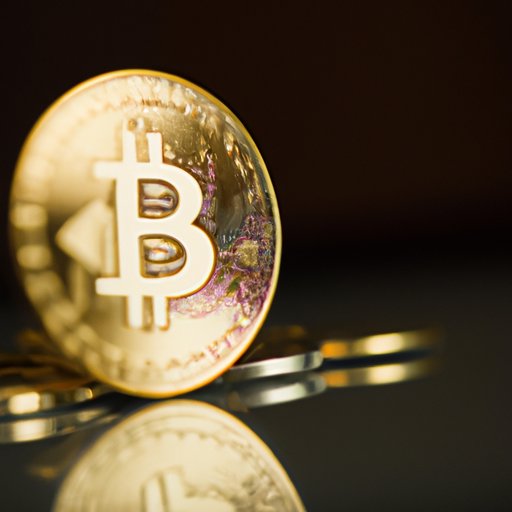
Introduction
Bitcoin is a type of cryptocurrency, which is a digital or virtual currency secured by cryptography. Bitcoin is revolutionary in that it is decentralized, meaning that it is not controlled by any government or central authority. It was created in 2009, and since then has grown rapidly in popularity and value.
The concept of Bitcoin as a digital currency has sparked debate among people from all walks of life. In this article, we will explore the concept of Bitcoin as a digital currency, examine its features and evolution, and compare it to traditional money. We will also look at the pros and cons of investing in it, and how it can be used in everyday life.

Exploring the Concept of Bitcoin as a Digital Currency
What is Bitcoin? Bitcoin is a decentralized digital currency that uses cryptography to secure transactions and control the creation of new units of the currency. Transactions are recorded on a public ledger known as the blockchain, and each transaction is verified by a network of computers. Bitcoin is different from traditional currencies because it is not issued or backed by any government or central bank.
What are the features of Bitcoin? Bitcoin is designed to be a secure and anonymous form of payment. It is also highly divisible, meaning that it can be divided into smaller units for easier use. Bitcoin transactions are also fast and inexpensive, making it ideal for international payments. Finally, Bitcoin is deflationary, meaning that its supply is limited, making it a scarce asset.
How does Bitcoin work? Bitcoin works through a process called mining. Miners are computer systems that solve complex cryptographic puzzles in order to verify transactions and add them to the blockchain. In return for their work, miners are rewarded with newly minted Bitcoins. This process is known as proof-of-work, and it helps to ensure the security and integrity of the Bitcoin network.
What makes Bitcoin different from traditional money? Bitcoin is different from traditional money in several ways. Firstly, it is decentralized, meaning that it is not controlled by any government or central bank. Secondly, it is not backed by any physical commodity, such as gold or silver. Thirdly, it is highly divisible, making it easier to use. Finally, it is deflationary, meaning that its supply is limited and it has the potential to increase in value over time.

The History and Evolution of Bitcoin
Origins of Bitcoin: The history of Bitcoin dates back to 2008 when a person or group of people known as Satoshi Nakamoto published a white paper describing a new form of digital currency called Bitcoin. The white paper outlined the technical details of the currency, such as its decentralized nature and its use of cryptography. In 2009, the first Bitcoin block was mined, and the Bitcoin network was born.
Development of Bitcoin over time: Since its inception, Bitcoin has seen tremendous growth in both usage and value. As more people adopted Bitcoin, more businesses began to accept it as a form of payment. This increased its utility and helped to drive up its price. Over the years, Bitcoin has become more secure and user-friendly, making it easier for people to adopt and use it.
Current status of Bitcoin: Today, Bitcoin is one of the most popular and valuable cryptocurrencies in the world. It has a market capitalization of over $200 billion, making it one of the largest assets in the world. It is accepted by many merchants and businesses, and it is becoming increasingly popular as a form of payment.
Examining the Pros and Cons of Investing in Bitcoin
Advantages of investing in Bitcoin: One of the biggest advantages of investing in Bitcoin is its potential for long-term growth. Many experts believe that Bitcoin has the potential to increase in value over time. Additionally, investing in Bitcoin can provide diversification benefits, as it is uncorrelated to other asset classes. Finally, Bitcoin is a liquid asset, meaning that it can be easily bought and sold.
Disadvantages of investing in Bitcoin: Despite its potential for long-term growth, there are some risks associated with investing in Bitcoin. Firstly, it is highly volatile, meaning that its price can fluctuate significantly. Secondly, it is not regulated, so investors may not have the same protections as they do with other investments. Finally, it is still relatively new, so it is difficult to predict its future performance.
How Bitcoin is Used in Everyday Life
Examples of ways Bitcoin can be used: Bitcoin can be used to purchase goods and services online. It can also be used to send money to family and friends quickly and securely. Additionally, it can be used to invest in stocks, bonds, and other assets. Finally, it can be used to pay for travel expenses, such as flights and hotels.
Potential uses of Bitcoin in the future: In the future, Bitcoin could be used to pay for utilities and rent, as well as for international payments. Additionally, it could be used to purchase real estate and to pay taxes. Finally, it could be used to facilitate peer-to-peer lending, allowing individuals to borrow and lend money without going through a bank.

Comparing Bitcoin to Traditional Money
Differences between Bitcoin and traditional money: Bitcoin is different from traditional money in several ways. Firstly, it is decentralized, meaning that it is not controlled by any government or central bank. Secondly, it is not backed by any physical commodity, such as gold or silver. Thirdly, it is highly divisible, making it easier to use. Finally, it is deflationary, meaning that its supply is limited and it has the potential to increase in value over time.
Advantages and disadvantages of using Bitcoin versus traditional money: There are both advantages and disadvantages to using Bitcoin instead of traditional money. On the one hand, Bitcoin is faster and cheaper to use than traditional money. On the other hand, it is more volatile and less secure than traditional money. Ultimately, the decision to use Bitcoin over traditional money comes down to individual preference.
Conclusion
In conclusion, Bitcoin is a revolutionary digital currency that has the potential to revolutionize the way we transact and exchange value. It is secure, anonymous, and fast, making it ideal for international payments. It is also deflationary, meaning that its supply is limited and it has the potential to increase in value over time. While there are some risks associated with investing in Bitcoin, it is becoming increasingly popular as a form of payment, and its use is only expected to increase in the future.
Overall, Bitcoin is an exciting and innovative technology that has the potential to revolutionize the way we think about money and finance. For those looking to invest in Bitcoin, it is important to understand the risks as well as the potential rewards. With the right education and research, Bitcoin can be a powerful tool for achieving financial freedom.
(Note: Is this article not meeting your expectations? Do you have knowledge or insights to share? Unlock new opportunities and expand your reach by joining our authors team. Click Registration to join us and share your expertise with our readers.)