
Introduction: Exploring the Speed of Light
Light wave propagation is one of the most fundamental aspects of physics. It’s a fascinating phenomenon that has been studied for centuries and holds many secrets yet to be uncovered. But one thing that scientists do know is the speed of light. In this article, we’ll explore the speed of light, including historical discoveries, current estimates, and factors that affect light wave velocity.
A Closer Look at the Speed of Light: The Physics Behind Light Wave Propagation
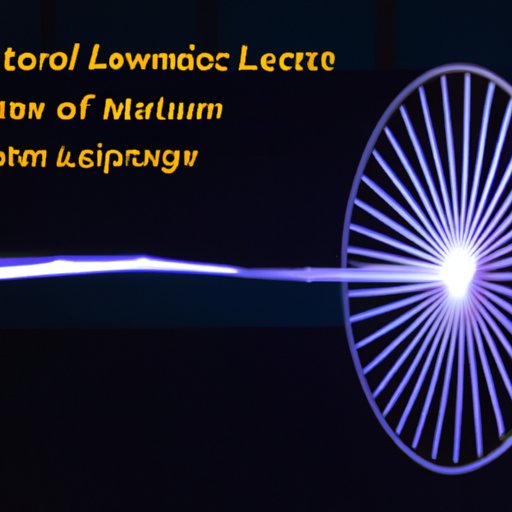
At its core, light wave propagation is the transfer of energy through electromagnetic radiation. When a charged particle accelerates, it produces an electric field that radiates outward in all directions. This electric field creates an oscillating magnetic field, which then radiates outward in all directions and produces electromagnetic waves. These waves propagate through space at a constant speed, known as the speed of light.
The basic physics behind light wave propagation are relatively simple. However, there are many factors that can affect the speed of light, such as the medium through which it is traveling, the temperature of the medium, and other environmental conditions. We’ll discuss these factors in more detail later in this article.
Shedding Light on the Speed of Light: An Overview of Light Wave Velocity
Throughout history, various scientists have studied the speed of light. In 1676, Ole Rømer famously estimated the speed of light to be approximately 220,000 kilometers per second. In 1728, James Bradley proposed that light traveled faster than anything else in nature. Finally, in the late 19th century, Albert Michelson and Edward Morley conducted experiments that revealed the true speed of light, which was determined to be 299,792.458 km/s.
Today, the speed of light is still widely accepted to be approximately 300,000 km/s in a vacuum. However, when light travels through other materials, such as air, water, or glass, its speed is slightly slower. For example, in air, light travels at approximately 299,700 km/s, while in water it travels at around 225,000 km/s.
Measuring the Speed of Light: How Scientists Determine Light Wave Speeds
Measuring the speed of light is no easy task. To measure the speed of light, scientists must use a variety of tools and techniques. One of the most basic tools used is the Michelson interferometer, which uses two mirrors to create an interference pattern that can be used to measure the speed of light.
In addition to the Michelson interferometer, scientists use advanced techniques such as laser interferometry and atomic clocks to measure the speed of light. These techniques allow scientists to measure the speed of light with extreme accuracy, and they are the basis of the current accepted value of 299,792.458 km/s.
Breaking Down the Speed of Light: Examining the Factors That Affect Light Wave Velocity
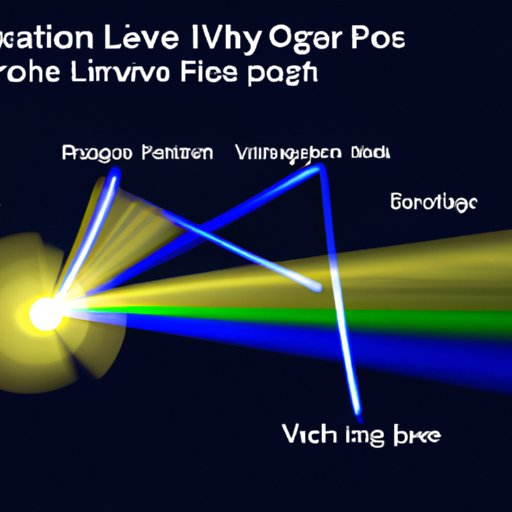
As mentioned earlier, there are several factors that can affect the speed of light. Environmental factors, such as temperature, pressure, and humidity, can all cause light to travel at different speeds. Additionally, certain materials, such as glass, water, and air, can slow down the speed of light.
Other factors, such as gravity and the presence of magnetic fields, can also affect the speed of light. For example, in a strong gravitational field, light will travel slower than it would in a weaker field. Similarly, the presence of a magnetic field can cause light to bend, which can also affect its speed.
Conclusion: Understanding the Speed of Light and Its Implications
Light wave propagation is one of the most important phenomena in physics, and understanding its speed is essential for advancing our knowledge of the universe. From historical discoveries to current estimates, we now know that the speed of light is approximately 300,000 km/s in a vacuum, and that it can be affected by environmental factors and other conditions.
By exploring the speed of light, scientists can gain a better understanding of how the universe works and how light interacts with other forms of matter. Ultimately, this knowledge can help us unlock the mysteries of the cosmos and further our exploration of the universe.
(Note: Is this article not meeting your expectations? Do you have knowledge or insights to share? Unlock new opportunities and expand your reach by joining our authors team. Click Registration to join us and share your expertise with our readers.)