
Introduction
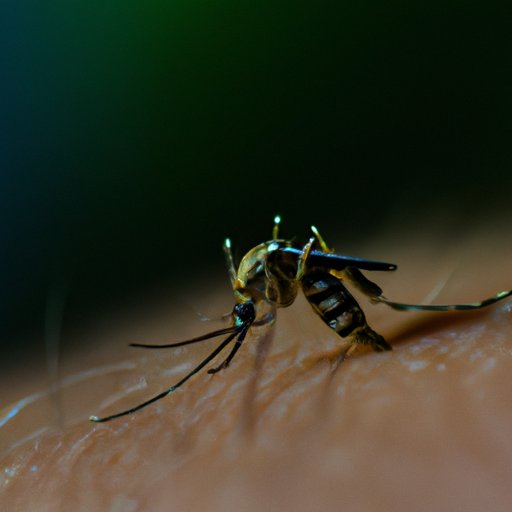
Mosquitoes are small flying insects that belong to the Culicidae family. They have long legs and a narrow body with two wings and a proboscis. Mosquitoes are known for their annoying buzzing sound and for the itchy bites they leave behind. But how far do these tiny creatures actually travel?
In this article, we’ll explore the migration patterns and flight capabilities of different mosquito species. We’ll look at factors such as seasonal changes, human activity, climate change, and wind direction to gain an understanding of how far mosquitoes can travel.

Tracking the Migration Patterns of Mosquitoes
Studying the migration paths of mosquitoes can provide valuable insights into their travel habits. In a study conducted by researchers at the University of California, Davis, scientists tracked the movements of adult female Aedes aegypti mosquitoes over a period of three months. The results showed that the mosquitoes traveled up to 4 kilometers from their initial release point.
The research also revealed seasonal variations in the mosquitoes’ movements. During the summer months, the mosquitoes were more likely to move further from the release site, while in the winter they stayed closer to home. This suggests that mosquitoes may be more active during the warmer months when food sources are abundant.

Exploring the Range of a Mosquito
Understanding the maximum distance a mosquito can travel is important for predicting its range. Studies have shown that mosquitoes can fly up to 1 kilometer in a single day. However, the actual distance will depend on factors such as wind speed and direction, temperature, and humidity.
In addition to flight distance, researchers have also looked at the maximum altitude at which mosquitoes can fly. Studies have found that mosquitoes can fly up to 3,000 meters above sea level. Again, this number can vary depending on environmental conditions.
Examining the Impact of Human Activity on Mosquito Travel
Humans have a significant impact on the habitats of mosquitoes and the distances they travel. Urbanization has led to the destruction of natural wetlands, which are essential breeding grounds for many mosquito species. This has resulted in a decrease in the overall population of mosquitoes in urban areas.
Pollution is another factor that can affect the travel patterns of mosquitoes. Studies have shown that pollutants such as nitrogen dioxide can reduce the lifespan of mosquitoes and deter them from entering certain areas.
How Climate Change is Affecting Mosquito Movement
Climate change is having a major impact on the travel habits of mosquitoes. Warmer temperatures have led to an increase in the number of mosquitoes in some areas. This has resulted in a larger range for some species, as they are able to survive in areas that were previously too cold for them.
In addition, climate change has also caused changes in the migration patterns of mosquitoes. For example, some species are now migrating earlier in the season due to warmer temperatures. This has implications for the spread of mosquito-borne diseases, as these diseases can be transmitted over greater distances.
The Role of Wind in Mosquito Flight Paths
Wind plays an important role in determining the flight paths of mosquitoes. Research has found that mosquitoes tend to fly in the direction of the wind, as it helps them conserve energy. Wind speed and direction can also influence the distance a mosquito is able to travel in a single day.
In addition, wind direction can also affect the direction in which a mosquito is able to fly. Studies have shown that mosquitoes tend to fly against the wind as they are unable to fight against strong winds. This means that wind direction can limit the range of a mosquito if it is blowing in the wrong direction.

Investigating the Flight Capacity of Different Mosquito Species
The ability of mosquitoes to travel long distances depends on the species. Some species are known for their long-distance migrations, such as the Aedes aegypti mosquito which is capable of traveling up to 4 kilometers in a single day. Other species, such as the Anopheles gambiae, are not as adept at traveling long distances and usually stay within a few hundred meters of their breeding sites.
In addition, there are differences in the flight abilities of male and female mosquitoes. Female mosquitoes, which need blood meals to produce eggs, generally have better flight capabilities than males. Males, on the other hand, are more likely to stay close to their breeding sites.
Conclusion
In conclusion, this article has explored the migration patterns and flight capabilities of different mosquito species. We’ve looked at factors such as seasonal changes, human activity, climate change, and wind direction to gain an understanding of how far mosquitoes can travel. We’ve seen that the range of a mosquito depends on the species, with some able to travel up to 4 kilometers in a single day. We’ve also seen that human activity and climate change can have a major impact on the travel habits of mosquitoes.
Overall, this article has provided an insight into the fascinating world of mosquito travel. While mosquitoes may be annoying pests, they are also an important part of our ecosystem. Understanding their travel habits can help us protect against the spread of mosquito-borne diseases and ensure our environment remains healthy.
(Note: Is this article not meeting your expectations? Do you have knowledge or insights to share? Unlock new opportunities and expand your reach by joining our authors team. Click Registration to join us and share your expertise with our readers.)