
Introduction
A long-range missile is a type of weapon system that is capable of delivering a payload to a distant target. These missiles typically have ranges of several hundred to several thousand kilometers and are used by militaries around the world for various purposes. This article will explore the range of long-range missiles, their historical development, the technology behind them, and the differences in the maximum distances of various types of long-range missiles from different countries.
Historical Development of Long-Range Missiles
The history of long-range missiles can be traced back to the early 20th century, when they were first developed as an alternative to traditional artillery. Early long-range missiles relied on gunpowder or solid fuel propulsion systems, and their accuracy was limited by the technology of the time. In the 1950s, the development of more advanced liquid-fueled rockets allowed for greater range and accuracy, and the first intercontinental ballistic missiles (ICBMs) were developed during this period.
In the decades since, advances in propulsion, guidance, and other technologies have enabled even further increases in the range and accuracy of long-range missiles. Modern missiles can travel thousands of kilometers with pinpoint accuracy, and some can even reach targets on the other side of the globe. As a result, long-range missiles have become a key part of military strategy around the world.
The Technology Behind Long-Range Missiles
The range of a long-range missile is largely determined by its propulsion system and guidance system. Propulsion systems can be either solid-fueled or liquid-fueled, and each type has its own advantages and disadvantages. Solid-fueled systems are more reliable and easier to store, but they offer less thrust than liquid-fueled systems. Liquid-fueled systems, on the other hand, provide more thrust but require more complex storage and fueling systems.
The guidance system of a long-range missile is also key to its range. Guidance systems can vary from simple inertial guidance systems to more complex GPS-based guidance systems. The more accurate the guidance system, the greater the range of the missile. In addition, factors such as the weight of the payload and the drag of the atmosphere can also affect the maximum range of a long-range missile.
Types of Long-Range Missiles and Their Maximum Distances
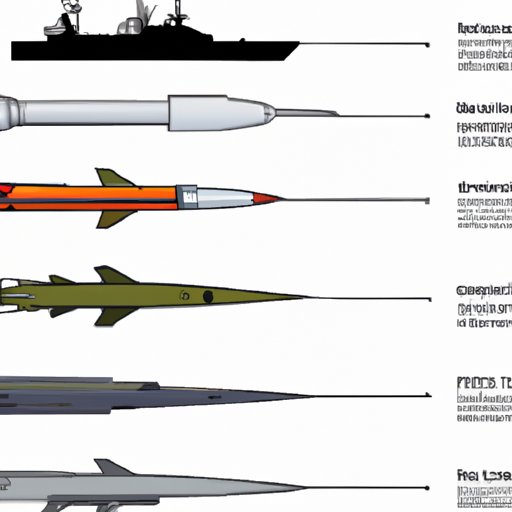
Long-range missiles can be divided into three main categories: short-range ballistic missiles (SRBMs), intermediate-range ballistic missiles (IRBMs), and intercontinental ballistic missiles (ICBMs). SRBMs have ranges of up to 1,000 kilometers, IRBMs have ranges of up to 5,500 kilometers, and ICBMs have ranges of up to 12,000 kilometers. In addition, some countries have developed missiles with even greater ranges, such as Russia’s RS-28 Sarmat ICBM, which has a range of up to 16,000 kilometers.
Comparison of Long-Range Missiles From Different Countries
The range of long-range missiles can vary significantly between different countries. For example, the United States has developed a number of long-range missiles with ranges of up to 12,000 kilometers, such as the Trident II D5 SLBM. Russia, meanwhile, has developed missiles with ranges of up to 16,000 kilometers, such as the RS-28 Sarmat ICBM. China has also developed a number of long-range missiles with ranges of up to 12,000 kilometers, including the DF-41 ICBM. India, meanwhile, has developed a number of short-range ballistic missiles with ranges of up to 700 kilometers, such as the Agni-I SRBM.
Conclusion
In conclusion, long-range missiles have come a long way since their early development in the 20th century. Advances in propulsion, guidance, and other technologies have enabled them to travel farther and with greater accuracy. The range of a long-range missile is largely determined by its propulsion system and guidance system, and different types of missiles have different maximum ranges. Finally, the range of long-range missiles can vary significantly between different countries, with some countries having missiles with ranges of up to 16,000 kilometers.
(Note: Is this article not meeting your expectations? Do you have knowledge or insights to share? Unlock new opportunities and expand your reach by joining our authors team. Click Registration to join us and share your expertise with our readers.)