
Introduction
As the popularity of cryptocurrencies grows, more people are interested in learning about how miners earn Bitcoin and other digital assets. This article will explore the process of Bitcoin mining, the rewards miners receive, and the potential risks.
Exploring the Process of Bitcoin Mining and How Miners Earn Bitcoin
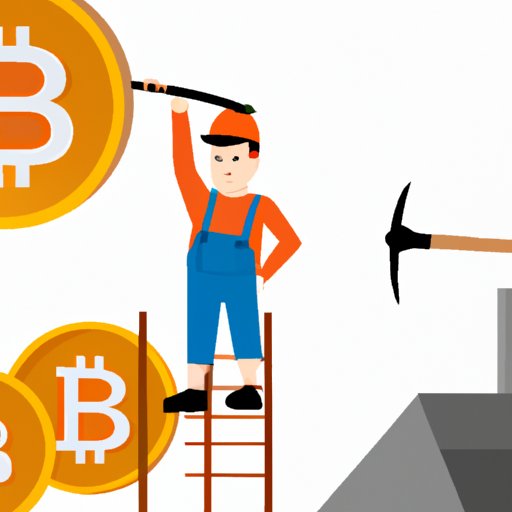
Bitcoin mining is the process of validating new transactions on the blockchain and creating new blocks. The miners compete to solve complex mathematical puzzles using specialized hardware, and the first miner to solve the puzzle is rewarded with newly created Bitcoin. The process of mining is an essential part of the security and stability of the Bitcoin network, as it incentivizes miners to secure the network and prevents double-spending.
In order to participate in mining, a miner must have access to specialized hardware, such as ASICs (application-specific integrated circuits) or GPUs (graphics processing units). In addition, miners must have access to electricity and a reliable internet connection in order to run the mining equipment. Furthermore, miners must also have access to a Bitcoin wallet in order to store their rewards.
There are two main types of mining: solo mining and pool mining. Solo mining involves a single miner competing against other miners to solve the puzzle and receive the reward. Pool mining involves multiple miners working together to solve the puzzle and share the reward. Pool mining is more profitable than solo mining due to the increased chances of solving the puzzle and receiving the reward.

An Overview of Bitcoin Mining Rewards and How They are Distributed
The reward for successfully mining a block is 12.5 newly created Bitcoin. This reward is halved every 210,000 blocks, which occurs approximately every four years. Additionally, the miners receive all of the transaction fees associated with the transactions included in the block. These fees vary depending on the size and complexity of the transactions.
The rewards are distributed to the miners according to their contribution to the pool. In solo mining, the miner who solves the puzzle receives the entire reward. In pool mining, the reward is split among all the miners in the pool according to their contribution.
The rewards can be used by the miners in a variety of ways. They can be sold for fiat currency, exchanged for other cryptocurrencies, or held as an investment. Additionally, some miners use the rewards to purchase additional mining hardware in order to increase their profits.
Examining the Economics of Bitcoin Mining and How Profits are Generated
The cost of mining depends on the type of hardware being used, the cost of electricity, and other factors. Generally speaking, the more powerful the hardware, the higher the cost. Additionally, miners must factor in the cost of cooling the hardware, as well as the cost of maintenance and repairs.
Profitability is determined by a number of factors, including the current price of Bitcoin, the cost of electricity, the cost of hardware, and the difficulty of the network. As the difficulty of the network increases, the rewards become smaller and the amount of time needed to solve the puzzle increases. As such, profitability can decrease if the difficulty increases too quickly.
In order to maximize profits, miners can use a variety of strategies, such as using more efficient hardware, taking advantage of cloud mining services, and utilizing mining pools. Additionally, miners can take advantage of arbitrage opportunities by buying and selling Bitcoin when the price is favorable.

Understanding the Benefits of Bitcoin Mining for Miners
Bitcoin mining provides a number of advantages for miners. Firstly, miners can generate passive income by running their mining equipment. Secondly, miners can benefit from the appreciation of Bitcoin, as they are rewarded with newly created Bitcoin. Lastly, miners can benefit from transaction fees associated with the transactions included in the block.
Pool mining is another way for miners to increase their profits. By joining a mining pool, miners can combine their computing power and increase their chances of solving the puzzle and receiving the reward. Additionally, the rewards are split among all the miners in the pool according to their contribution.
Finally, miners can also take advantage of cloud mining services. Cloud mining allows miners to access the necessary hardware and resources without having to purchase and maintain their own hardware. This can be a cost-effective way for miners to get started with mining.

Investigating the Challenges Faced by Bitcoin Miners and How to Overcome Them
Mining is not without its challenges. One of the biggest challenges is competition. As more miners join the network, the difficulty of the network increases, which leads to lower rewards and longer times to solve the puzzle. Additionally, miners must constantly monitor the market and adjust their strategies accordingly in order to remain competitive.
Another challenge is the cost of electricity. As the difficulty of the network increases, the cost of electricity can become prohibitively expensive. Miners must find ways to reduce their electricity costs in order to remain profitable.
Finally, there are also risks associated with mining. These include the risk of theft, fraud, and hackers. Miners must take steps to secure their hardware and wallets in order to protect their rewards.
Conclusion
Bitcoin mining is an essential part of the security and stability of the Bitcoin network, and miners are rewarded with newly created Bitcoin for their efforts. Mining is a complex process that requires specialized hardware, electricity, and a reliable internet connection. Miners can also benefit from transaction fees associated with the transactions included in the block. Mining rewards can be used in a variety of ways, such as selling for fiat currency, exchanging for other cryptocurrencies, or holding as an investment. However, mining is not without its challenges, such as competition, high electricity costs, and the risk of theft, fraud, and hackers. Miners must take steps to mitigate these risks in order to remain profitable.
(Note: Is this article not meeting your expectations? Do you have knowledge or insights to share? Unlock new opportunities and expand your reach by joining our authors team. Click Registration to join us and share your expertise with our readers.)