

Introduction
Bitcoin is a digital currency that has become increasingly popular over the last few years. It is based on a decentralized system known as the blockchain, which uses peer-to-peer technology to allow users to securely transfer money without the need for a third party or central authority. It has gained traction due to its low transaction fees, wide acceptance, and high level of security.
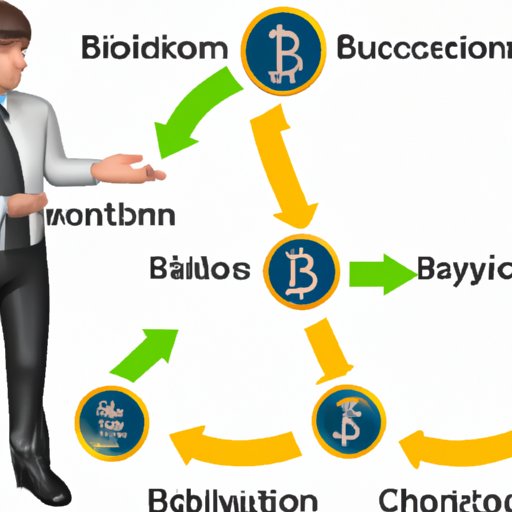
Explaining the Process of Bitcoin Transactions
A Bitcoin transaction is an exchange between two parties that involves the transfer of bitcoins from one person’s wallet to another. To make a transaction, both parties must have a Bitcoin wallet, which is an online account that holds the individual’s balance of bitcoins. The transaction process begins when the sender initiates the transfer by entering the recipient’s wallet address into their own wallet software.
The next step is for the sender to provide the amount of bitcoins they want to send, as well as any fees associated with the transaction. Once the information is verified, the transaction is broadcast to the network and each node in the network will validate the inputs and outputs of the transaction. If all the inputs and outputs are correct, the transaction is added to the blockchain, which is a public ledger of all Bitcoin transactions.
Once the transaction is confirmed by the network, it is considered complete and the funds are credited to the recipient’s wallet. This entire process can take anywhere from a few minutes to several hours, depending on the size of the transaction and the congestion of the network.

Outlining the Benefits of Using Bitcoins
The use of bitcoins has numerous advantages, making it an attractive option for many people. Some of the most notable benefits include:
Cost-Effective
One of the main advantages of using bitcoins is that it is a cost-effective way of sending and receiving money. Since there is no third-party or middleman involved, the transaction fees for using bitcoins are typically much lower than those associated with traditional payment methods. This makes it a great option for those who need to send or receive money quickly and cheaply.
Fast and Secure
Another benefit of using Bitcoin is that it is fast and secure. Transactions are usually processed within minutes, and since they are encrypted and distributed across a network of computers, they are virtually impossible to hack or alter. This makes it a great choice for those who need to send money quickly and securely.
Worldwide Acceptance
Bitcoin is accepted by merchants and individuals around the world, making it a great option for those who need to make international payments. Since it is not tied to any particular country or currency, it is easy to convert bitcoins into any currency you may need.
Anonymous
Finally, Bitcoin is a great option for those who value their privacy. Since transactions are handled by the blockchain, the identity of the sender and receiver is not revealed. This makes it a great option for those who want to keep their financial information private.
Describing the Bitcoin Network
The Bitcoin network is a global network of computers that use the blockchain technology to manage and verify transactions. The network is composed of nodes, which are computers connected to the blockchain and responsible for validating transactions. These nodes are spread out around the globe and run the open source software that allows them to participate in the Bitcoin network.
The nodes communicate with each other to verify transactions and ensure that the blockchain remains up-to-date. They also work together to prevent double-spending and fraud, as well as to maintain the security of the network. In addition, miners are responsible for verifying transactions and creating new blocks on the blockchain.
As a reward for their efforts, miners are given newly created bitcoins as compensation. This process helps to ensure that the Bitcoin network remains secure and efficient, and it is what allows the network to function without the need for a central authority.

Analyzing the Security of Bitcoin
The security of Bitcoin is ensured through the use of encryption and mining. Encryption prevents hackers from accessing user accounts and stealing funds, while mining ensures that all transactions are valid and that new blocks are created at regular intervals. Additionally, users are encouraged to store their bitcoins in a secure wallet in order to protect their funds.
Encryption
All Bitcoin transactions are encrypted using a cryptographic algorithm called SHA-256. This algorithm is used to ensure that the data contained in a transaction cannot be modified or forged in any way. As a result, all Bitcoin transactions are highly secure and virtually impossible to hack.
Mining
Mining is the process of verifying Bitcoin transactions and adding them to the blockchain. Miners use special computer hardware to solve complex mathematical puzzles in order to verify transactions and create new blocks. As a reward for their efforts, miners are rewarded with newly created bitcoins.
Storage
In addition to encryption and mining, users are encouraged to store their bitcoins in a secure wallet in order to protect their funds. A wallet is an online account that holds the individual’s balance of bitcoins. Wallets come in different forms, such as desktop, mobile, and web-based wallets, each with their own set of features and security measures.
Comparing Traditional Currencies to Bitcoin
Traditional currencies, such as the US dollar and the euro, are physical forms of money issued by governments and backed by central banks. They are widely accepted and are used to facilitate trade and commerce around the world. On the other hand, Bitcoin is a digital currency that is not backed by any government or central bank. Instead, it is based on a decentralized system known as the blockchain.
What is a Traditional Currency?
A traditional currency is a form of money issued by a government and backed by a central bank. These currencies are used to facilitate trade and commerce around the world and are accepted by merchants and individuals worldwide. They are generally printed on paper notes or coins and are regulated by the government.
Advantages & Disadvantages of Traditional Currencies Compared to Bitcoin
Traditional currencies offer many advantages, such as being widely accepted and having a long history of use. However, they also have some drawbacks, such as being subject to inflation and manipulation by governments and central banks. Bitcoin, on the other hand, offers many advantages, such as low transaction fees, fast processing times, and worldwide acceptance. However, it is still relatively new and is not yet widely accepted by merchants and individuals.
Examining the History of Bitcoin
Bitcoin was created in 2009 by an anonymous individual (or group) known as Satoshi Nakamoto. Since then, it has grown to become one of the most popular digital currencies in the world. Here are some of the major milestones in the history of Bitcoin:
- 2009 – Bitcoin is created and released to the public.
- 2011 – Bitcoin reaches parity with the US dollar.
- 2013 – Bitcoin price rises to $1,000.
- 2017 – Bitcoin reaches a market capitalization of $100 billion.
- 2019 – Bitcoin reaches an all-time high of $20,000 per coin.
Investigating the Future of Bitcoin
Bitcoin has seen tremendous growth over the past few years, but it still faces many challenges. These include scalability issues, regulatory uncertainty, and the lack of widespread acceptance by merchants and individuals. Despite these challenges, many believe that Bitcoin has a bright future ahead.
Challenges Facing Bitcoin
Some of the biggest challenges facing Bitcoin include scalability issues, regulatory uncertainty, and the lack of widespread acceptance by merchants and individuals. Scalability refers to the ability of the blockchain to handle increasing amounts of transactions, while regulatory uncertainty refers to the lack of clear regulations governing the use of Bitcoin. Finally, the lack of widespread acceptance means that it can be difficult to find merchants who accept Bitcoin payments.
Potential Solutions
There are several potential solutions to these challenges, including the implementation of new technologies such as the Lightning Network and SegWit, as well as the introduction of clearer regulations. Additionally, more merchants are beginning to accept Bitcoin payments, which could help to increase its adoption.
Predictions for Bitcoin’s Future
Many experts believe that Bitcoin will continue to grow in the coming years, with some predicting that it could reach a market capitalization of $1 trillion in the near future. Despite the challenges it faces, Bitcoin has already achieved remarkable success and is likely to remain a popular digital currency for years to come.
Conclusion
Bitcoin is a popular digital currency that is based on a decentralized system known as the blockchain. It has numerous advantages, such as low transaction fees, fast processing times, and worldwide acceptance. Additionally, it is secured by encryption and mining, and is becoming increasingly accepted by merchants and individuals around the world. Despite the challenges it faces, Bitcoin has already achieved remarkable success and is likely to remain a popular digital currency for years to come.
(Note: Is this article not meeting your expectations? Do you have knowledge or insights to share? Unlock new opportunities and expand your reach by joining our authors team. Click Registration to join us and share your expertise with our readers.)