
Introduction
Artificial intelligence (AI) is a form of technology that enables machines to perform tasks that normally require human intelligence. It has been around in various forms since the 1950s but has become increasingly popular in recent years as businesses and individuals alike have sought to take advantage of its capabilities. AI can be used for a variety of purposes, including data analysis, automation, and decision-making. In this article, we’ll explore how AI works and the different types, technologies, and algorithms used to power it.
Exploring Different Types of AI and How They Work
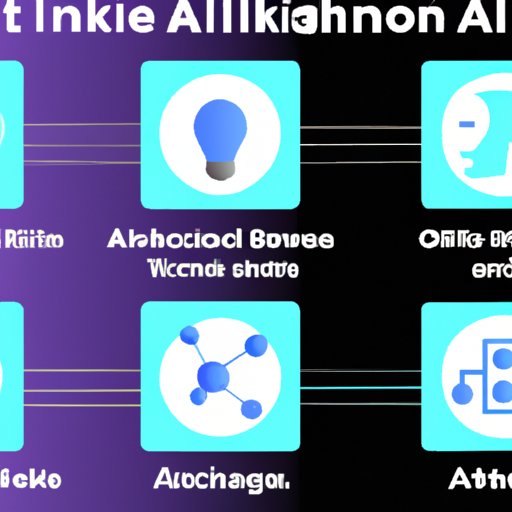
There are three main types of AI: rule-based AI, machine learning, and deep learning. Each type operates differently and has its own set of advantages and disadvantages. Let’s take a closer look at each one.
Rule-Based AI
Rule-based AI, also known as symbolic AI, is the most basic form of AI. It involves programming a computer to follow a set of predefined rules to reach a desired outcome. This type of AI is often used for relatively simple tasks such as playing games or sorting data. For example, a chess-playing computer would be programmed to follow certain rules in order to determine its next move.
Machine Learning
Machine learning is a type of AI that enables a computer to learn from data without being explicitly programmed. It involves using algorithms to parse data and identify patterns, which the computer can then use to make decisions and predictions. For example, a machine learning algorithm might be used to analyze customer data in order to predict their purchasing habits. According to a study by Accenture, “machine learning can help businesses reduce costs, increase productivity and improve customer experience.”
Deep Learning
Deep learning is a type of machine learning that uses artificial neural networks to process data. The neural networks are modeled after the human brain, and are composed of layers of interconnected nodes. These nodes process the data and generate output, allowing the computer to “learn” from the data. Deep learning is often used for complex tasks such as facial recognition, natural language processing, and self-driving cars.

Examining the Benefits and Challenges of AI
AI offers many potential benefits, but it also poses some challenges. Let’s take a look at both sides of the equation.
Benefits of AI
The primary benefit of AI is its ability to automate mundane tasks, freeing up time for humans to focus on more creative endeavors. AI can also be used to analyze large amounts of data quickly and accurately, enabling businesses to make better decisions. Additionally, AI can be used to improve customer service, providing personalized experiences tailored to each individual customer.
Challenges of AI
One of the biggest challenges with AI is determining who is liable when things go wrong. If an AI system makes a mistake, it can be difficult to tell who is responsible for the error. Additionally, AI systems are only as good as the data they are fed, so any biases or errors in the data will be reflected in the output. Finally, there are concerns about privacy and security when it comes to AI systems, as hackers may attempt to gain access to sensitive information.

A Deep Dive Into AI Algorithms and Technologies
In order for AI systems to function properly, they must be powered by algorithms and technologies. Let’s take a closer look at these components.
Algorithms
An algorithm is a set of instructions that a computer follows to solve a problem. AI algorithms are designed to enable computers to learn from data and make decisions without human input. Common AI algorithms include supervised learning, unsupervised learning, reinforcement learning, and evolutionary algorithms.
Technologies
AI technologies are tools used to build AI systems. These technologies range from basic software applications to sophisticated hardware solutions. Some common AI technologies include natural language processing, computer vision, and robotics.
The Future of AI and What it Could Mean for Humanity
AI has the potential to revolutionize the way we live and work, but it also poses some risks. Let’s take a look at the potential benefits and challenges of AI.
Potential Benefits of AI
AI could potentially create new jobs, improve healthcare outcomes, and make transportation faster and safer. AI could also help us better understand our environment and develop sustainable solutions to climate change. Additionally, AI could be used to automate tedious tasks, freeing up time for humans to pursue more meaningful activities.
Potential Challenges of AI
The potential risks associated with AI include job losses, increased inequality, and privacy concerns. Additionally, AI systems could be used for malicious purposes such as cyber-attacks and political manipulation. Finally, AI systems could lead to ethical dilemmas, such as deciding who is responsible for a decision made by the system.
Conclusion
AI is a rapidly evolving field that has the potential to revolutionize the way we live and work. In this article, we explored how AI works, the different types, technologies, and algorithms used, and the potential benefits and challenges. As AI continues to evolve, it’s important to keep an eye on the potential risks while also taking advantage of the potential benefits.
(Note: Is this article not meeting your expectations? Do you have knowledge or insights to share? Unlock new opportunities and expand your reach by joining our authors team. Click Registration to join us and share your expertise with our readers.)