
Introduction
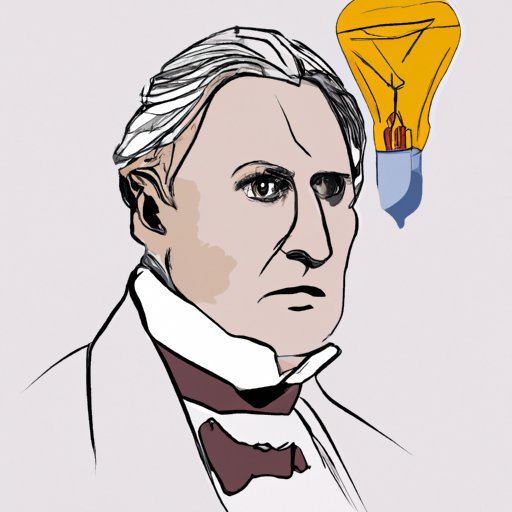
The lightbulb is one of the most iconic inventions of all time, symbolizing progress and innovation. But who invented the lightbulb? This question has been the source of much debate for decades, with many crediting Thomas Edison as the inventor. To understand the truth behind this claim, it is important to explore Edison’s role in the invention and look at other individuals who have been credited with the invention.
Examining Edison’s Role in the Invention of the Lightbulb
Thomas Edison is often credited as the inventor of the electric lightbulb, but it is important to note that he did not invent the technology alone. Edison was an American inventor who worked on improving existing technologies and developing new ones. He was a prolific inventor, holding 1,093 US patents in his lifetime. Edison’s primary focus was on electric lighting and he was particularly interested in creating a reliable and long-lasting electric lightbulb.
Edison began work on the lightbulb in 1878 and eventually developed a successful prototype in 1879. He then patented his invention in 1880, receiving US Patent 223,898. Edison continued to improve his lightbulb design and was granted several more patents related to the invention. These included US Patent 228,619 (1880) and US Patent 223,898 (1881).

Exploring the Controversy Surrounding Who Invented the Lightbulb
Despite Edison’s patents, there is still much controversy surrounding who invented the lightbulb. This is due to the fact that there were several other people working on similar technologies at the same time. For example, British physicist Joseph Swan received a UK patent for an improved version of the lightbulb in 1878. This predates Edison’s patent by two years and some argue that Swan should be credited as the inventor.
Another individual credited with the invention of the lightbulb is American inventor Hiram Maxim. Maxim was working on a different type of electric lamp at the same time as Edison and was granted a US patent in 1883. While Maxim’s invention was not as successful as Edison’s, some argue that he should be credited as a co-inventor of the lightbulb.
It is difficult to determine who should be credited with the invention of the lightbulb, as there is no clear answer. Those who argue for Edison point to his numerous patents and contributions to the development of the technology. Those who argue against him point to the fact that others were working on similar technologies at the same time. Ultimately, it is up to each individual to decide who they believe should be credited as the inventor.
The History Behind the Invention of the Lightbulb
Before Edison began work on the lightbulb, there were several other types of lighting solutions. Candles and oil lamps were the primary sources of illumination for centuries, but these had significant drawbacks. They were unreliable and could not provide enough light for larger areas or public spaces. In the early 1800s, scientists began experimenting with gas lighting, which provided brighter and more efficient lighting than candles and oil lamps. Gas lighting was quickly adopted in homes and businesses and remained the primary source of illumination until the late 1800s.
By the 1870s, scientists had begun experimenting with electric lighting. Many inventors were trying to create a reliable and long-lasting electric lightbulb, but none of their efforts were successful. It wasn’t until Edison began working on the project in 1878 that a successful prototype was created. Edison’s invention was the first to use a carbonized filament, which allowed the bulb to last longer and provide brighter light than previous designs.
A Look at the Impact of the Lightbulb on Modern Life
The invention of the lightbulb had a profound impact on modern life. It allowed people to extend their day beyond sunset and made it possible to work and study after dark. The technology quickly spread across the world and can now be found in almost every home. Electric lighting has also enabled us to explore new frontiers, such as deep sea diving and space exploration. In addition, the lightbulb has enabled medical advances, such as surgery and X-ray imaging.
The global reach of lightbulb technology is evident in the fact that it is estimated that over 6 billion people around the world use electric lighting. This has made a huge difference in quality of life, especially in developing countries. By providing access to light, electric lighting has improved education and economic opportunities. It has also enabled people to stay safe at night, as well as enjoy leisure activities after dark.

How the Lightbulb Changed the World
The invention of the lightbulb changed society in many ways. It allowed people to stay awake later and improved productivity. It also made it possible to illuminate large public spaces, such as stadiums and theaters. This enabled people to gather in larger numbers, which led to increased social interaction and community building.
In addition, the lightbulb enabled advances in communication and transportation. Telegraph lines and railway networks could now be illuminated, allowing messages to be sent quickly and efficiently. This enabled people to travel further distances and opened up new opportunities for trade and commerce.
The Rivalry Between Edison and His Contemporaries
Edison’s invention of the lightbulb was part of a larger rivalry between him and his contemporaries. Edison was a competitive person and was eager to prove himself in the face of competition. He was constantly striving to create better and more efficient inventions than his competitors. This rivalry drove him to perfect his lightbulb design and develop other inventions, such as the phonograph and the motion picture camera.
Edison’s main rivals were Joseph Swan and Hiram Maxim. Swan had been working on a lightbulb design before Edison and was granted a UK patent in 1878. Similarly, Maxim was working on a different type of electric lamp at the same time as Edison and was granted a US patent in 1883. Despite their efforts, Edison was ultimately successful in creating the first commercially viable electric lightbulb.

Analyzing the Numerous Patents for the Lightbulb
As previously mentioned, Edison was granted several patents related to the invention of the lightbulb. These included US Patent 223,898 (1880) and US Patent 228,619 (1881). Edison’s patents covered the use of a carbonized filament in the bulb, as well as improvements to the bulb’s efficiency and durability. These patents helped protect Edison’s invention from being copied and ensured that he would receive credit and profits for his work.
Other inventors were also granted patents related to the lightbulb. These included Swan’s UK patent and Maxim’s US patent. While these patents do not cover the same elements as Edison’s, they are still important as they demonstrate that there were other individuals working on similar technologies at the same time as Edison.
Conclusion
The invention of the lightbulb is one of the most important technological developments in history. While Thomas Edison is often credited as the inventor, the truth is more complicated. Edison played a key role in the development of the technology, but there were several other individuals who contributed to its success. Ultimately, it is up to each individual to decide who they believe should be credited with the invention of the lightbulb.
(Note: Is this article not meeting your expectations? Do you have knowledge or insights to share? Unlock new opportunities and expand your reach by joining our authors team. Click Registration to join us and share your expertise with our readers.)