
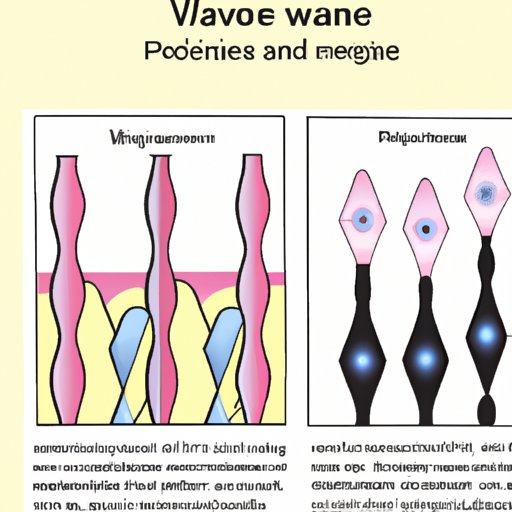
Introduction
Wave propagation refers to the movement of energy through a medium, which can be any material that transmits the wave. Waves can take many forms, such as sound, light, and radio waves. Understanding how waves travel through different materials is essential when designing structures, developing communication systems, diagnosing medical conditions, and more.
The purpose of this article is to explain the scientific principles behind wave propagation, the practical applications in different fields, the historical evolution of wave theory, and the complex systems that affect wave behavior.
Scientific Explanation
Waves are defined as disturbances that travel through a medium, causing a transfer of energy from one point to another. The medium can be a solid, liquid, or gas, and the energy can be in the form of sound, light, or electromagnetic radiation.
The mathematical equation describing the propagation of a wave is as follows:
c=fλ
where c is the speed of the wave, f is the frequency, and λ is the wavelength. The speed of the wave is determined by the properties of the medium it travels through.
There are several types of waves, including mechanical waves, electromagnetic waves, and matter waves. Mechanical waves, such as sound waves, require a medium to travel through. Electromagnetic waves, such as light and radio waves, can travel through a vacuum.
Examples of wave propagation through different mediums include sound waves traveling through air, light waves traveling through transparent materials such as glass, and radio waves traveling through the atmosphere.
Practical Applications
The principles of wave propagation have numerous practical applications in several fields, including communication, medicine, and engineering.
Radio Waves
Radio waves transmit information through the air by modulating the frequency of the wave. The frequency of the wave determines its wavelength, which is then used to carry the message. Radio communication systems, such as cell phones and radios, use this principle to send and receive signals.
Sound Waves
Sound waves are propagated through different materials, including solids, liquids, and gases. The properties of the material, such as its density and elasticity, affect the speed and direction of the sound wave. Sound absorption and reflection are essential factors in acoustic engineering and design to create optimal listening environments.
Historical Evolution
The earliest theories of wave propagation date back to ancient Greek philosophers, such as Pythagoras and Aristotle. Isaac Newton introduced the notion that light waves consisted of particles, which was later disproved in experiments conducted by Thomas Young.
The modern understanding of wave theory was revolutionized by James Clerk Maxwell’s electromagnetic theory and Albert Einstein’s theory of relativity, which helped explain the behavior of waves in space and time.
Real World Examples
Engineers have used wave theory to design better materials for specific applications, such as soundproofing materials and anti-vibration materials. Acoustic engineers use the principles of wave absorption and reflection to create optimal listening environments. In structural engineering, the principles of wave propagation are used to design buildings to withstand seismic activity.
Doctors use ultrasound technology to diagnose medical conditions by transmitting and receiving high-frequency sound waves through the body. Medical conditions diagnosed using ultrasound include internal injuries, tumors, and pregnancy-related issues.
Complex Systems
The interaction between waves and materials is a complex system that affects wave behavior. Wave scattering and absorption are essential factors in designing materials with specific acoustic properties.
Interference between waves can be constructive, where waves combine to create a larger wave, or destructive, where waves combine to cancel each other out. This principle is used in optics and communication systems to transmit and receive signals.
Factors affecting wave speed and direction include dispersion and refraction. Seismologists use these principles to study wave propagation through the Earth’s layers, while oceanographers study wave behavior in the ocean.
Conclusion
Wave propagation through a medium is a fundamental concept in fields ranging from physics and engineering to medicine and communication. Understanding how waves travel through different materials is essential when designing structures, developing communication systems, diagnosing medical conditions, and more.
The principles of wave theory have evolved over time, from ancient Greek philosophers to modern-day physicists and engineers. The study of wave propagation through complex systems has led to advances in material design, medical technology, and communication systems.
Understanding wave theory is essential for creating optimal listening environments, designing structures to withstand seismic activity, and diagnosing medical conditions. By improving our understanding of the principles of wave propagation, we can continue to make advancements in various fields that rely on wave theory.
(Note: Is this article not meeting your expectations? Do you have knowledge or insights to share? Unlock new opportunities and expand your reach by joining our authors team. Click Registration to join us and share your expertise with our readers.)