

Introduction
Knitting is a craft that has been around for centuries. It is an activity that involves using two needles, yarn or thread to create fabric by interlocking loops of yarn. Knitting can be done by hand or with a machine, and it is used to make clothing, blankets, accessories, and other items. As a craft, it has a rich history and understanding its origins can help us to appreciate the skill and artistry that goes into creating knitted items.
In this article, we will explore when knitting was invented and trace its origins back to its beginnings. We will look at how knitting has changed through the ages and what implications this has for future research.
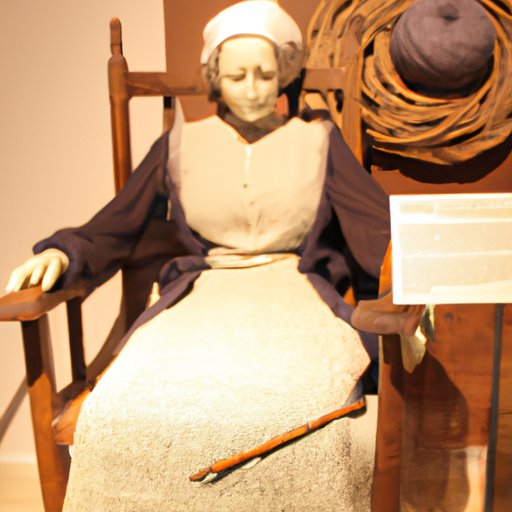
A Historical Look at the Invention of Knitting
Tracing the origins of knitting back to its beginnings can be quite difficult as there is not much written evidence about the early history of knitting. However, there is some archaeological evidence that suggests that knitting was practiced in Egypt as early as the 11th century CE. There are also references to knitting in literature from the 12th century, suggesting that it was already a well-established craft by this time.
The earliest known knitted item is thought to be a pair of socks found in Egypt and dated to the 11th century. These socks were made of cotton and wool, suggesting that knitting was already a sophisticated craft by this time. It is also believed that knitting was practiced in Europe during the Middle Ages, although the oldest surviving knitted items from this period are from the 16th century.
Unraveling the mystery of when knitting was invented is complicated by the fact that there have been many different forms of knitting throughout history. For example, some cultures have practiced a form of knitting where one needle is used to loop the yarn around itself to create a stitch, while others have used two needles to interlock the stitches. This means that trying to pinpoint an exact date for the invention of knitting is difficult, as it likely evolved over time in different parts of the world.
How Knitting Changed Through the Ages
Exploring the development of knitting through time gives us insight into how the craft has evolved over the centuries. During the Middle Ages, knitting was mainly used to make stockings and other garments. By the 17th century, knitting had become a popular pastime and was being used to make more decorative items such as lace and shawls. The Industrial Revolution saw the introduction of mechanized knitting machines, which allowed for the mass production of knitted items.
In the 19th century, knitting began to be seen as a form of artistic expression, with knitters experimenting with different techniques and stitches to create intricate designs. This led to the emergence of the modern craft of knitting, with people using knitting as a way to create unique and beautiful items.
Discovering the evolution of knitting throughout history is important as it helps us to understand the importance of the craft and appreciate the skill and creativity that goes into creating knitted items. Knitting has a long and rich history, and understanding its origins can help us to appreciate the craft and all of its possibilities.
Conclusion
This article has explored when knitting was invented and traced its origins back to its beginnings. We have looked at how knitting has changed through the ages and the implications this has for future research. We have seen that knitting is an ancient craft that has evolved over time and is now seen as a form of artistic expression.
It is clear that knitting is an important part of our cultural heritage, and understanding its history is essential for appreciating the skill and creativity that goes into creating knitted items. By exploring the origins of knitting, we can gain a greater appreciation for the craft and the artistry that it entails.
(Note: Is this article not meeting your expectations? Do you have knowledge or insights to share? Unlock new opportunities and expand your reach by joining our authors team. Click Registration to join us and share your expertise with our readers.)