
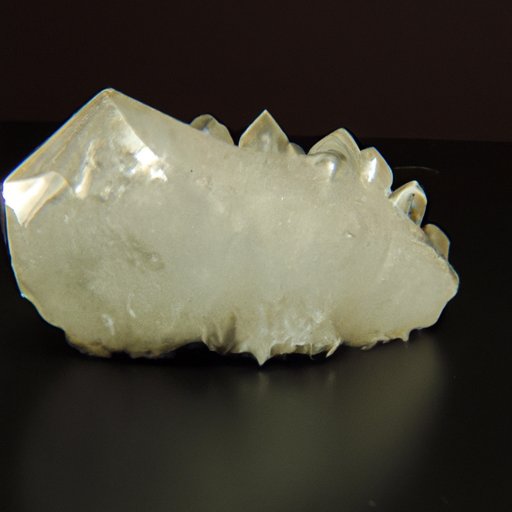
Introduction
Quartz is one of the most abundant minerals on Earth. It is found in various forms, from massive rock formations to tiny grains of sand, and it is used in many different industries. But the question remains: Is quartz a mineral or a rock? To answer this question, we must look at its composition, physical properties, formation, and uses.
Analyzing the Composition of Quartz: Is It a Mineral or Rock?
The chemical composition of quartz can help us determine whether it is a mineral or rock. Quartz is composed of two elements: silicon and oxygen. The ratio of these two elements is 1:2, meaning there is twice as much oxygen as silicon. This makes quartz a silicate mineral, which is a type of mineral that contains both silicon and oxygen atoms.
How does this relate to determining whether quartz is a mineral or rock? Minerals are defined as naturally occurring substances that are made up of specific chemical compositions and have distinct physical properties. Rocks, on the other hand, are made up of aggregates of minerals, organic matter, or both. Thus, based on its chemical composition, quartz can be classified as a mineral.

Exploring the Physical Properties of Quartz to Determine Its Mineral or Rock Status
In addition to its chemical composition, the physical properties of quartz can also help us decide whether it is a mineral or rock. Quartz has a hexagonal crystal structure, meaning it has six sides. It can range in color from clear to white, yellow, pink, purple, gray, and black. It is also transparent to translucent in clarity.
Finally, quartz is quite hard, with a Mohs hardness rating of 7 out of 10. This means that it is harder than glass but softer than diamonds. All of these physical properties indicate that quartz is indeed a mineral.

Examining How Quartz is Formed to Classify It as a Mineral or Rock
To further classify quartz as a mineral or rock, we must look at how it is formed. Quartz is formed through a variety of geological processes, including hydrothermal activity, metamorphism, and sedimentation. These processes involve heat and pressure, which cause the quartz crystals to form.
Quartz can form in a variety of environments, including igneous, metamorphic, and sedimentary rocks. This indicates that quartz is a mineral, as it is formed through natural processes and has a distinct chemical composition.
Investigating the Uses of Quartz to Decide Whether it’s a Mineral or Rock
The uses of quartz can also help us determine whether it is a mineral or rock. Historically, quartz was used for jewelry, tools, and weapons. Today, it is used in a variety of industries, including electronics, optics, construction, and even medical applications. All of these uses indicate that quartz is a mineral.
Comparing Quartz to Other Minerals and Rocks to See if it Fits Into Either Category
Finally, let’s compare quartz to other minerals and rocks to see if it fits into either category. Quartz is similar to other silicate minerals such as feldspar and mica in terms of its chemical composition, crystal structure, and hardness. However, quartz is quite different from other rocks such as granite and basalt, which are composed of multiple minerals and organic materials.
Based on all of the above factors, quartz can be classified as a mineral rather than a rock.
Conclusion
In conclusion, quartz is a mineral, not a rock. This conclusion is based on its chemical composition, physical properties, formation, and uses. Quartz is composed of silicon and oxygen, has a hexagonal crystal structure, and is used in a variety of industries. It is also formed through geological processes and is similar to other silicate minerals such as feldspar and mica. All of these factors indicate that quartz is indeed a mineral.
(Note: Is this article not meeting your expectations? Do you have knowledge or insights to share? Unlock new opportunities and expand your reach by joining our authors team. Click Registration to join us and share your expertise with our readers.)