
Introduction
Bitcoin mining is the process of verifying and adding new transactions to the public ledger, known as the blockchain. Bitcoin miners utilize powerful computers and specialized software to solve complex mathematical equations in order to validate transactions and receive rewards for their efforts. Although the concept of mining Bitcoin may seem simple, there are many challenges associated with this process that make it difficult and time consuming. In this article, we will explore why Bitcoin is hard to mine and the various challenges associated with this process.
Analyzing the Complexity of Bitcoin Mining
In order to understand why Bitcoin is hard to mine, it is important to first examine the complexity of the mining process. Bitcoin mining is based on a proof-of-work consensus algorithm, which requires miners to solve complex mathematical equations in order to validate transactions and receive rewards for their efforts. This process is extremely computationally intensive and requires sophisticated hardware and software in order to be successful.
The complexity of Bitcoin mining is further compounded by the hash rate, which is the measure of how quickly a miner can solve these equations. As more miners join the network, the hash rate increases, making it more difficult for an individual miner to successfully validate transactions and receive rewards.

Exploring the Challenges of Mining Bitcoin
There are several challenges associated with mining Bitcoin that make it difficult and time consuming. The most significant challenge is the difficulty adjustment, which is a mechanism by which the difficulty of the equations is adjusted periodically in order to ensure that blocks are mined at a consistent rate. As the difficulty increases, it becomes more difficult for miners to validate transactions and receive rewards.
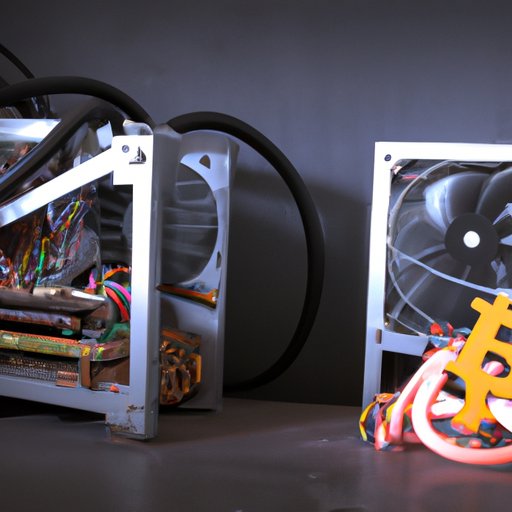
Another challenge associated with mining Bitcoin is the need for specialized mining hardware. Mining hardware is designed specifically for the task of mining Bitcoin and is significantly more powerful than regular computer hardware. This specialized hardware is expensive and requires a large initial investment in order to be effective.
Finally, mining Bitcoin consumes a significant amount of energy. This is due to the fact that mining Bitcoin is a highly computationally intensive process that requires powerful computers and specialized software to be successful. As the number of miners on the network increases, the amount of energy consumed by the network also increases.
Examining the Costs Involved in Mining Bitcoin
In addition to the challenges associated with mining Bitcoin, there are also costs involved in this process. The most significant cost is the initial investment in specialized mining hardware. This hardware is expensive and requires a large upfront cost in order to be effective. Additionally, there are ongoing operating costs associated with mining Bitcoin, such as electricity, cooling, and maintenance.
Evaluating the Difficulty of Bitcoin Mining
The difficulty of Bitcoin mining is constantly changing and is adjusted periodically in order to ensure that blocks are mined at a consistent rate. The difficulty level is determined by the hash rate, which is the measure of how quickly a miner can solve the equations. As the hash rate increases, the difficulty of mining Bitcoin also increases, making it more difficult for an individual miner to successfully validate transactions and receive rewards.

Understanding Bitcoin Mining Difficulty Adjustments
In order to maintain a consistent block time, Bitcoin employs a difficulty adjustment mechanism which adjusts the difficulty of the equations periodically. This helps to ensure that blocks are mined at a consistent rate and prevents miners from having an unfair advantage over other miners. The difficulty adjustment algorithm takes into account the total hash rate of the network in order to determine the appropriate level of difficulty.

Investigating the Impact of Specialized Mining Hardware
Specialized mining hardware is designed specifically for the purpose of mining Bitcoin and is significantly more powerful than regular computer hardware. This specialized hardware is expensive and requires a large initial investment in order to be effective. However, it does provide an advantage to miners as it allows them to mine more efficiently and effectively.
The biggest disadvantage of specialized mining hardware is that it is only suitable for mining Bitcoin and cannot be used for other purposes. Additionally, it requires a large upfront investment and is subject to rapid changes in technology, making it difficult to keep up with the latest advancements.

Looking into the Energy Consumption of Bitcoin Mining
The energy consumption of Bitcoin mining is one of the most significant challenges associated with this process. Mining Bitcoin is an extremely computationally intensive process that requires powerful computers and specialized software to be successful. As the number of miners on the network increases, the amount of energy consumed by the network also increases.
In order to reduce the energy consumption of Bitcoin mining, some miners have begun to explore alternative energy sources such as solar and wind power. These alternative energy sources are renewable and have the potential to significantly reduce the energy consumption of Bitcoin mining.
Conclusion
Mining Bitcoin is a complex and challenging process that requires specialized hardware, a large initial investment, and significant energy consumption. Additionally, the difficulty of mining Bitcoin is constantly changing due to difficulty adjustments and the increasing hash rate of the network. Despite these challenges, many people still find mining Bitcoin to be an attractive option due to the potential rewards and the ability to help secure the Bitcoin network.
(Note: Is this article not meeting your expectations? Do you have knowledge or insights to share? Unlock new opportunities and expand your reach by joining our authors team. Click Registration to join us and share your expertise with our readers.)