
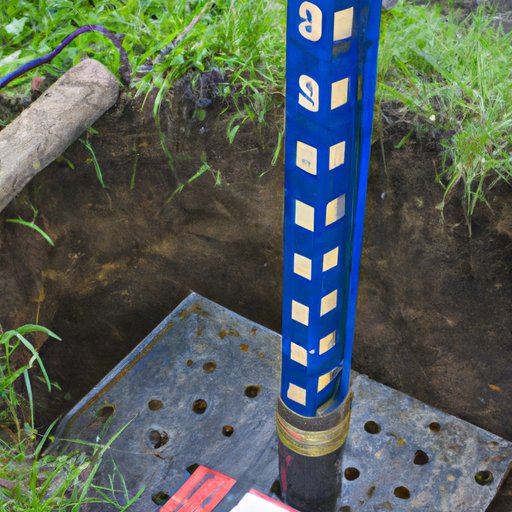
Introduction
A well is an excavation made in the ground by digging, driving, or drilling to access groundwater in underground aquifers. The depths of these wells can range from a few feet to hundreds of feet. In this article, we will explore how deep the average well is and the factors that determine its depth. We will also look at different types of wells and the techniques used to measure their depths.

Exploring Well Depths: An Overview of the Average Well
A well is defined as an artificial hole in the ground created by digging, drilling, or driving to tap into groundwater. Wells are typically drilled with a specialized piece of equipment called a drill rig. Depending on the type of well, the associated depth can vary significantly. For example, a shallow well is generally between 20 and 50 feet deep, while a deep well can be up to 400 feet deep.
The depth of a well depends on several factors, such as the location of the well, the type of soil, and the water table. The water table is the upper surface of the saturated zone of an aquifer, which is the layer of underground material that holds groundwater. If the water table is close to the surface, then the well does not need to be very deep. Conversely, if the water table is deeper, then the well must be drilled deeper in order to access the groundwater.
What Lies Below? A Look at How Deep an Average Well Is
The average well depth is usually between 75 and 300 feet. This range is based on data collected from numerous studies, including a study conducted by the U.S. Geological Survey that examined the depths of wells across the United States. The study found that most wells ranged from 75 to 300 feet in depth, with some exceptions reaching depths of up to 500 feet.
The depth of an average well is determined by various factors, including the water table and the type of soil. If the water table is close to the surface, then the well does not need to be very deep. On the other hand, if the water table is lower, then the well must be drilled deeper in order to access the groundwater.
In addition, the type of soil can also affect the depth of the well. Soils that are softer and more porous, such as sand and gravel, require less effort to drill through and therefore do not require as deep of a well. Conversely, harder and denser soils, such as clay or bedrock, require more effort to drill through and thus require deeper wells.
Delving Deeper: Uncovering the Depths of the Average Well
There are several methods used to measure the depths of wells. The most common method is to use a tape measure, which is lowered down the well until it reaches the bottom. This method is accurate but requires someone to physically enter the well, which can be dangerous. Other methods include using a sonar device to measure the depth, or using a pressure gauge to measure the water pressure at different depths.
Well depths can also be calculated by measuring the amount of water pumped from the well. This method uses a pump to draw water from the well and measure the rate of flow. By measuring the rate of flow, it is possible to calculate the depth of the well. This method is often used when drilling new wells and can provide accurate measurements without having to physically enter the well.
The Depths of a Well: How Far Down Does It Go?
The depths of different types of wells vary depending on the type of soil and the water table. Shallow wells, which are typically between 20 and 50 feet deep, are often used for residential applications and irrigation. Deep wells, which can reach depths of 200-400 feet, are typically used for industrial and agricultural applications. These wells are typically drilled through hard rock and require specialized equipment.
The water table can also affect the depth of a well. If the water table is close to the surface, then the well does not need to be very deep. However, if the water table is lower, then the well must be drilled deeper in order to access the groundwater. In addition, the type of soil can also affect the depth of the well.
How Deep is a Typical Well? Examining the Average Depth
The average well depth is usually between 75 and 300 feet. This range is based on data collected from numerous studies, including a study conducted by the U.S. Geological Survey. Factors such as the water table and the type of soil can influence the depth of the well. Harder and denser soils, such as clay or bedrock, require deeper wells than softer and more porous soils, such as sand and gravel.
When drilling a well, it is important to take into consideration the depth of the well and the type of soil it will be drilled through. The depth of the well should be determined by the water table and the type of soil. It is also important to consider the potential for future water needs when determining the depth of the well.

A Guide to Well Depths: Understanding the Average Well
When choosing the depth of a well, it is important to consider the water table, the type of soil, and any potential future water needs. It is also important to consider safety when drilling a well. It is recommended to use a professional drilling service to ensure that the well is properly constructed and maintained. Additionally, it is important to choose a well depth that is sufficient to meet your current and future water needs.
Conclusion
The average well depth is usually between 75 and 300 feet, depending on the water table and the type of soil. When drilling a well, it is important to consider the water table, the type of soil, and any potential future water needs. Additionally, it is important to use a professional drilling service to ensure that the well is properly constructed and maintained. With these tips, you should be able to find the right well depth for your needs.
(Note: Is this article not meeting your expectations? Do you have knowledge or insights to share? Unlock new opportunities and expand your reach by joining our authors team. Click Registration to join us and share your expertise with our readers.)