
Introduction
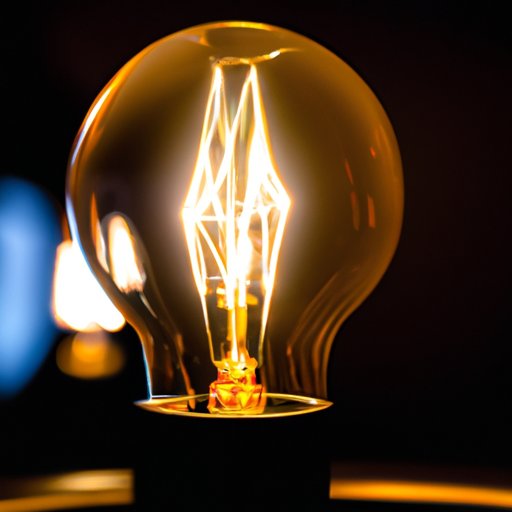
The lightbulb is one of the most important inventions in human history. It’s hard to imagine a world without electric lighting, but it was only relatively recently that humans were able to harness electricity to produce artificial light. This article will explore the history of the lightbulb and the different inventors who contributed to its invention and development.
A Historical Look at the Inventor of the Lightbulb
Electric lighting dates back to the early 19th century, when English scientist Humphry Davy created an arc lamp in 1809. The arc lamp used two electrodes to create a spark which produced a bright light. However, these lamps were very inefficient and dangerous, so they weren’t widely adopted. Over the next few decades, various inventors experimented with different ways to create electric lighting, but it wasn’t until the 1870s that the first practical incandescent lightbulb was invented.
In 1874, Canadian inventor Henry Woodward and American inventor Matthew Evans patented their own version of the incandescent lightbulb. However, their patent was bought by Thomas Edison in 1878, who improved and perfected the design. Edison’s version of the lightbulb featured a carbon filament that burned for up to 40 hours. His invention was the first to be commercially successful and ushered in the era of electric lighting.
Although Edison is often credited with the invention of the lightbulb, there were many other inventors who contributed to its development. Other notable figures include Joseph Swan, who developed his own incandescent lightbulb in the 1880s, and Nikola Tesla, who developed the alternating current system that allowed for the widespread adoption of electric lighting.

The Innovative Mind Behind the Invention of the Lightbulb
Thomas Edison is often referred to as the “father of electric light” and is credited with the invention of the lightbulb. Edison was an American inventor and businessman who held over 1,000 patents in his lifetime. He had a knack for taking existing ideas and improving them, which he did with the incandescent lightbulb.
Edison’s improvements included a longer-lasting filament, a better vacuum, and a higher wattage. He also invented the first electrical distribution system, which allowed for the widespread use of electric lighting. While Edison was the main force behind the invention of the lightbulb, other important figures include Joseph Swan and Nikola Tesla.

From Incandescence to LED: An Evolution of Lighting
Since Edison’s invention of the incandescent lightbulb in the late 19th century, there have been significant advances in lighting technology. Different types of lightbulbs have been developed, such as fluorescent, halogen, and LED bulbs. Each type of lightbulb has its own advantages and disadvantages.
Fluorescent bulbs are more energy efficient than incandescent bulbs, but they contain mercury, which can be hazardous if not disposed of properly. Halogen bulbs are brighter than incandescent bulbs, but they also use more energy. LED bulbs are the most energy efficient and long-lasting type of bulb available. They are also more expensive than other types of bulbs, but the cost savings in energy consumption makes them worth the investment.
Thomas Edison: The Father of Electric Light
Thomas Edison’s contributions to the world of electric lighting cannot be understated. His invention of the lightbulb changed the way we live and work, and his innovations paved the way for future advances in lighting technology. Edison was a prolific inventor and entrepreneur who is remembered as one of the most influential figures in history.
In addition to the lightbulb, Edison is credited with the invention of the phonograph, the motion picture camera, and the stock ticker. He also founded the first industrial research laboratory, which was responsible for a number of important scientific discoveries. Edison’s legacy lives on today in the form of the products and technologies he helped bring into existence.

Exploring Different Types of Lightbulbs and How They Came to Be
Lightbulbs have come a long way since Edison’s invention of the incandescent bulb. Today’s market offers a variety of different types of bulbs, each with their own advantages and disadvantages. Incandescent bulbs are the least energy efficient, but they are the cheapest option. Fluorescent bulbs contain mercury and require special disposal, but they are more energy efficient than incandescent bulbs.
Halogen bulbs are brighter than incandescent bulbs, but they are more expensive and use more energy. LED bulbs are the most energy efficient and long-lasting type of bulb, but they are also the most expensive. Regardless of the type of bulb you choose, it’s important to consider the environmental impact of your decision.
The Impact of the Lightbulb: How It Changed the World
The invention of the lightbulb has had a profound impact on society. Before the advent of electric lighting, people relied on candles and oil lamps for illumination. With the invention of the lightbulb, people were able to work and study after dark, which increased productivity and efficiency. It also made it possible for factories to operate during the night, revolutionizing the industrial sector.
Electric lighting has also had a major impact on technology. Without it, modern electronics such as computers and televisions would not exist. It has also enabled us to explore space, as satellites and spacecraft need electric lighting to function. Finally, electric lighting has had a huge impact on our lifestyle, allowing us to stay up later and enjoy more leisure time.
Conclusion
In conclusion, this article has explored the invention of the lightbulb and the minds behind it. It has looked at the early experiments with electric lighting, the development of the incandescent lightbulb, and the impact of the lightbulb on modern life. Most importantly, it has highlighted the genius of Thomas Edison and other innovators whose work has changed the world.
(Note: Is this article not meeting your expectations? Do you have knowledge or insights to share? Unlock new opportunities and expand your reach by joining our authors team. Click Registration to join us and share your expertise with our readers.)