
Introduction
Light energy is a form of electromagnetic radiation that can travel through space and is visible to the human eye. It is used in everyday life for many purposes, including communication, navigation, and entertainment. But how does light energy travel? In this article, we will explore the physics behind light energy and its pathway from source to destination.

Examining the Science Behind Light Energy and Its Pathway
Light energy is composed of different types of waves, including visible light, ultraviolet, infrared, and x-rays. These waves have distinct properties, such as frequency, wavelength, and amplitude, which determine how they interact with matter. Additionally, light waves are transverse waves, meaning they move perpendicular to the direction of their propagation.
Investigating How Light Travels Across Space
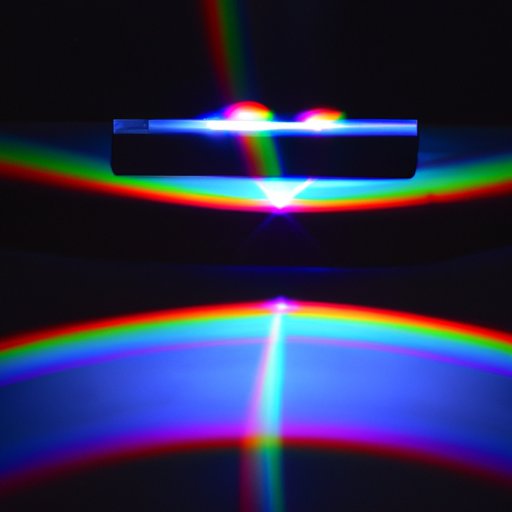
The movement of light through space depends on the behavior of light when it encounters other materials. When light strikes a surface, it can be reflected, refracted, or absorbed. Reflection occurs when light bounces off a surface, while refraction occurs when light passes through a medium and changes direction. Absorption occurs when light is taken in by a material and converted into another form of energy.
Additionally, interference can affect the path of light energy. Interference is when two or more waves interact and create a new wave pattern. Interference can cause constructive interference, where waves combine to create a larger wave, or destructive interference, where waves cancel each other out and reduce the overall wave size.

Light Energy: The Journey from Source to Destination
Light energy follows a specific pathway from its source to its destination. The process begins with the emission of the light wave, which is the starting point. From there, the wave moves through space until it reaches its destination, where it is either reflected, refracted, or absorbed.
The behavior of light also depends on its environment. For example, light waves can be affected by the presence of other particles, such as air molecules. This can cause the light to bend or scatter, resulting in diffraction. Diffraction is the bending of light around the edges of an obstacle or through an opening.

Mapping the Movement of Light Energy Through Space
The speed of light is constant in a vacuum, but it can be slowed down or sped up depending on the medium it is travelling through. For example, light travels faster through a vacuum than it does through air or water.
Light energy can also be absorbed by certain materials. This is why some objects appear darker than others; they absorb more light than they reflect. Additionally, some materials can convert light energy into other forms of energy, such as heat.
Conclusion
Light energy is an important part of our lives and understanding how it travels is essential. This article has explored the physics behind its pathway, from source to destination, and highlighted the effects of absorption, refraction, and diffraction on light energy. By understanding the journey of light energy, we can better appreciate its role in our everyday lives.
(Note: Is this article not meeting your expectations? Do you have knowledge or insights to share? Unlock new opportunities and expand your reach by joining our authors team. Click Registration to join us and share your expertise with our readers.)