
Introduction
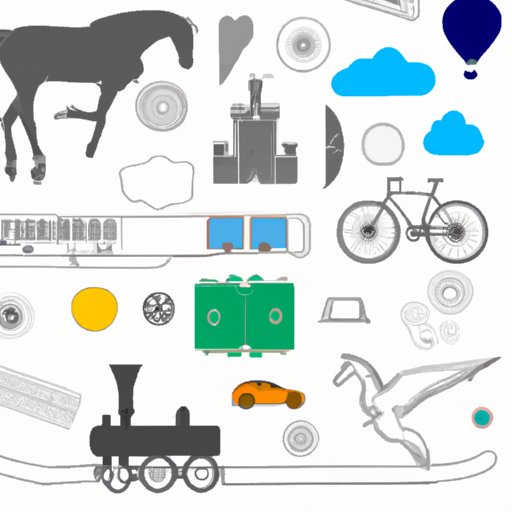
Personal freedom of travel is defined as the ability to move around freely without being hindered by external factors such as cost, time, or distance. Over the centuries, a number of notable inventions have enabled individuals to enjoy greater freedom of movement, allowing them to explore more of the world than ever before. In this article, we will take a look at some of the major innovations that have led to increased personal freedom of travel, and how they have transformed the way we get around.

Comparison of Innovations that Have Led to Greater Personal Freedom of Travel
The history of personal freedom of travel can be traced back to the early days of human civilization, when horse and carriage was the primary mode of transport. The invention of the automobile in the late 19th century revolutionized transportation, giving people the ability to travel faster and farther than ever before. The introduction of airplanes in the early 20th century further enhanced personal mobility, making it possible to reach destinations across the globe in just a few hours. Trains provided another option for long-distance travel, offering a comfortable and affordable way to get from one place to another.
More recently, the development of autonomous vehicles has opened up a whole new world of possibilities for personal freedom of travel. Autonomous cars are self-driving vehicles that are capable of navigating roads without human intervention. These vehicles are equipped with sensors and cameras that allow them to detect and respond to their environment, allowing them to drive safely and efficiently.
Impact of Inventions on Personal Mobility and Convenience
The inventions discussed above have had a profound impact on personal mobility and convenience. The advent of automobiles, airplanes, and trains has made it much easier and faster to travel from one place to another. For instance, a person who wanted to travel from New York to Los Angeles in the early 1900s would have had to take a train or boat, which could take up to several weeks. Today, however, the same journey can be completed in just a few hours via airplane.
In addition to saving time, these inventions have also improved safety. Automobiles, airplanes, and trains are all designed to operate under specific rules and regulations, which help to ensure that passengers are safe during their travels. Autonomous vehicles are also becoming increasingly popular due to their ability to navigate roads without human intervention, which can help to reduce the risk of accidents.
Greatest Breakthroughs in Transportation History
Some of the greatest breakthroughs in transportation history have been the invention of the steam engine, internal combustion engine, jet engines, electric cars, and autonomous vehicles. The steam engine, invented in the late 18th century, was the first successful application of mechanical power to enable transportation. The internal combustion engine, developed in the late 19th century, revolutionized transportation and ushered in the era of the automobile.
The invention of jet engines in the mid-20th century enabled airplanes to fly faster, higher, and farther than ever before. Electric cars, developed in the late 20th century, offer an eco-friendly alternative to gasoline-powered vehicles, while autonomous vehicles are paving the way for a future of driverless transportation.
How Technology Has Transformed the Way We Get Around
The inventions discussed above have had a dramatic effect on the way we get around. Over the past few decades, there has been a significant increase in speed, with airplanes now capable of reaching speeds of up to Mach 5 (five times the speed of sound). This has dramatically reduced the amount of time needed to reach faraway destinations, allowing people to explore more of the world in shorter periods of time.
In addition to speed, the cost of transportation has also decreased significantly over the years. Airlines and other forms of public transportation have become more affordable, allowing more people to enjoy the benefits of personal freedom of travel. Furthermore, the emergence of ride sharing services such as Uber and Lyft has made it even easier and more affordable to get around.

Evolution of Travel: From Horse and Carriage to Autonomous Vehicles
The evolution of travel can be divided into three distinct periods: early transportation methods, the industrial revolution, and modern transportation. Early transportation methods were limited to horse and carriage, which were slow and unreliable. The invention of the steam engine during the industrial revolution enabled locomotives to move at higher speeds, making it possible to travel longer distances in shorter amounts of time.
In the modern era, technological advancements have enabled us to travel faster, farther, and more conveniently than ever before. Autonomous vehicles, in particular, represent the latest breakthrough in transportation technology, offering a glimpse into the future of personal mobility.

A Look at the Innovations That Have Enabled Greater Personal Freedom of Travel
In recent years, various innovations have enabled greater personal freedom of travel. GPS navigation systems have allowed drivers to easily locate their destination, while ride sharing applications such as Uber and Lyft have given people access to convenient and affordable transportation options. Drones are also being used to deliver goods and services, providing yet another way for people to enjoy greater freedom of movement.
Autonomous vehicles are perhaps the most revolutionary innovation in the realm of personal freedom of travel. These self-driving cars are capable of navigating roads without human intervention, allowing people to travel safely and conveniently. Autonomous vehicles are still in the early stages of development, but they promise to revolutionize the way we get around in the future.
Conclusion
In conclusion, various inventions have enabled greater personal freedom of travel over the centuries, from horse and carriage to autonomous vehicles. These inventions have saved time, increased access to destinations, and improved safety. The invention of the steam engine, internal combustion engine, jet engines, electric cars, and autonomous vehicles have all played a major role in transforming the way we get around. Technology has also enabled us to travel faster, farther, and more conveniently than ever before, thanks to GPS navigation, ride sharing applications, and drones.
The evolution of transportation has enabled us to enjoy unprecedented levels of personal freedom of travel. With the continued development of autonomous vehicles, this trend is likely to continue in the coming years, allowing us to explore more of the world than ever before.
(Note: Is this article not meeting your expectations? Do you have knowledge or insights to share? Unlock new opportunities and expand your reach by joining our authors team. Click Registration to join us and share your expertise with our readers.)