
Introduction
Dutch-American artist Willem de Kooning (1904-1997) was a leading figure in the Abstract Expressionist movement that dominated the art world in the mid-20th century. He is renowned for his bold use of color, expressive brushstrokes, and powerful imagery, which have made him one of the most influential artists of the modern era. In this article, we will explore de Kooning’s life and artistic legacy, examining the influence of Abstract Expressionism on his work, analyzing the visual elements of his paintings, investigating the themes in his art, and comparing his work to other 20th century masters.
Exploring De Kooning’s Life and Artistic Legacy
Willem de Kooning was born in Rotterdam, Netherlands in 1904. He grew up in a working-class family and had little formal art training, but he developed an interest in painting at an early age. At the age of 16, he began studying at the Academy of Fine Arts in Rotterdam and soon developed a passion for avant-garde art. In 1926, he decided to move to the United States, where he worked odd jobs while continuing to paint. By the 1940s, de Kooning had established himself as a leader in the Abstract Expressionist movement.
De Kooning’s style was heavily influenced by European modernism, especially Cubism and Surrealism. He was also inspired by the works of other 20th century masters such as Pablo Picasso, Joan Miro, and Jackson Pollock. His earliest works were abstract landscapes and still lifes, but he eventually began to focus on figurative paintings. He often used bold colors and expressive brushstrokes to create powerful images that explored the human condition.
Over the course of his career, de Kooning achieved numerous accolades, including a Guggenheim Fellowship in 1952 and a Gold Medal from the American Academy of Arts and Letters in 1964. He was also awarded the National Medal of Arts in 1977 and the Presidential Medal of Freedom in 1979. Today, de Kooning’s works are widely celebrated and can be seen in major museums around the world, including the Museum of Modern Art in New York.
Examining the Influence of Abstract Expressionism on De Kooning’s Work
Abstract Expressionism was a major force in the art world in the mid-20th century. It was characterized by gestural brushwork, vivid colors, and non-objective imagery. The movement was largely led by American painters such as Jackson Pollock, Mark Rothko, and Barnett Newman. De Kooning was heavily influenced by these artists and their approach to painting, and he adopted many of their techniques in his own work.
De Kooning embraced the freedom of expression that was central to Abstract Expressionism. He often used loose brushstrokes and vibrant colors to convey emotion and energy. He also incorporated elements of Cubism and Surrealism into his paintings, creating dynamic compositions with abstract forms and symbolic imagery. As art historian Robert Rosenblum stated, “De Kooning’s paintings stand out among all the other Abstract Expressionists for their combination of vigor and lyricism, their marriage of the real and the imaginary.”
Analyzing the Visual Elements of De Kooning’s Paintings
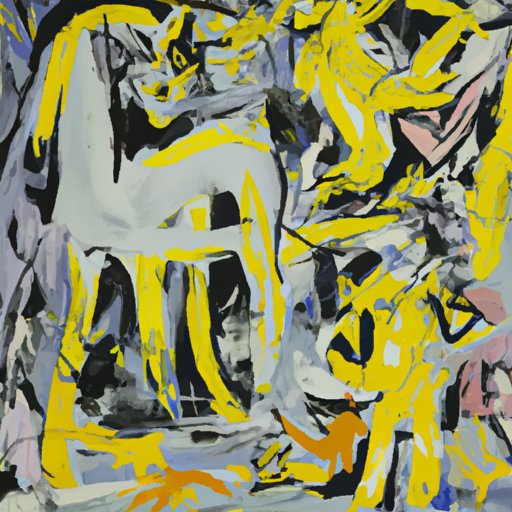
De Kooning’s paintings are characterized by bold colors, dynamic shapes, and expressive brushstrokes. He often used bright hues such as red, yellow, and blue to create dramatic effects. He also experimented with different textures and layers, creating complex compositions with overlapping forms and lines. In addition, he often used free-flowing brushstrokes to create a sense of movement in his paintings.
De Kooning’s use of color was particularly striking. He believed that color could be used to evoke emotion and energy, and he often employed vivid hues to create a sense of dynamism and intensity. He also used subtle color variations to create depth and contrast in his compositions. As art critic Clement Greenberg noted, “Although de Kooning’s work does not depend on any systematic use of color, it nevertheless shows a remarkable sensitivity to the emotional power of hue and value.”
Investigating the Themes in De Kooning’s Art
De Kooning’s work often explored themes of nature and landscapes, human figures, and women. He was particularly fascinated by the beauty and power of the natural world, and he often incorporated elements of landscape into his paintings. He also frequently depicted human figures, exploring the psychological complexities of the human experience. Lastly, he was known for his series of paintings featuring female figures, which he described as “the most beautiful thing there is.”
De Kooning’s artwork is highly personal and often reflects his innermost thoughts and feelings. He used his paintings to explore the human condition and express his emotions. As art historian Irving Sandler commented, “De Kooning’s art is deeply rooted in his particular experience of the world, and it is this that gives it its special power.”
Examining the Relationship Between De Kooning and His Contemporaries
De Kooning was closely associated with other Abstract Expressionists, including Jackson Pollock, Mark Rothko, and Barnett Newman. While each artist had their own distinct style, they shared a common interest in exploring the human psyche and expressing emotion through their art. They also often collaborated and exchanged ideas, pushing each other to new creative heights.
De Kooning’s work was particularly influenced by Pollock’s drip paintings. He was inspired by Pollock’s use of color and texture, and he often incorporated elements of Pollock’s style into his own paintings. He also admired Rothko’s use of color and light, and he was influenced by Newman’s use of geometric forms and spatial relationships. As art historian Barbara Rose observed, “De Kooning drew inspiration from each of them, yet his work is unmistakably his own.”
Understanding the Role of Color in De Kooning’s Work
Color played a crucial role in de Kooning’s work. He believed that color could be used to evoke emotion and energy, and he often employed vivid hues to create a sense of dynamism and intensity. He also used subtle color variations to create depth and contrast in his compositions. He was particularly fond of bold colors such as red, yellow, and blue, which he often combined in unexpected ways to create dazzling effects.
De Kooning also used color to convey his feelings and experiences. He often used warm colors such as orange and pink to express joy and optimism, and cool colors such as green and blue to express sadness and anxiety. As art critic David Sylvester commented, “De Kooning’s use of color…is always charged with feeling. He uses it to suggest moods, sometimes of joy, sometimes of anguish.”
Comparing De Kooning’s Art to Other 20th Century Masters
De Kooning was heavily influenced by other 20th century masters such as Pablo Picasso, Joan Miro, and Jackson Pollock. He was particularly inspired by Picasso’s Cubist paintings, which often featured fragmented forms and overlapping planes. He was also influenced by Miro’s Surrealist works, which often included dreamlike imagery and abstract forms. Lastly, he was inspired by Pollock’s drip paintings, which often featured bold colors and expressive brushstrokes.
De Kooning’s work often combined elements of these styles, creating dynamic compositions with abstract forms and symbolic imagery. His paintings were also characterized by vibrant colors, expressive brushwork, and dynamic shapes, which gave them a unique energy and vitality. As art critic Robert Rosenblum noted, “De Kooning’s paintings stand out among all the other Abstract Expressionists for their combination of vigor and lyricism, their marriage of the real and the imaginary.”
Conclusion
Willem de Kooning was a pioneering artist who helped shape the Abstract Expressionist movement in the mid-20th century. He is renowned for his bold use of color, expressive brushstrokes, and powerful imagery, which have made him one of the most influential artists of the modern era. This article has explored de Kooning’s life and artistic legacy, examining the influence of Abstract Expressionism on his work, analyzing the visual elements of his paintings, investigating the themes in his art, and comparing his work to other 20th century masters.
De Kooning’s work was heavily influenced by European modernism, especially Cubism and Surrealism. He also drew inspiration from the works of other 20th century masters such as Pablo Picasso, Joan Miro, and Jackson Pollock. His paintings are characterized by bold colors, dynamic shapes, and expressive brushstrokes, which give them a unique energy and vitality. De Kooning’s work continues to be celebrated and admired today, and his legacy remains a lasting testament to the power of abstract art.
(Note: Is this article not meeting your expectations? Do you have knowledge or insights to share? Unlock new opportunities and expand your reach by joining our authors team. Click Registration to join us and share your expertise with our readers.)